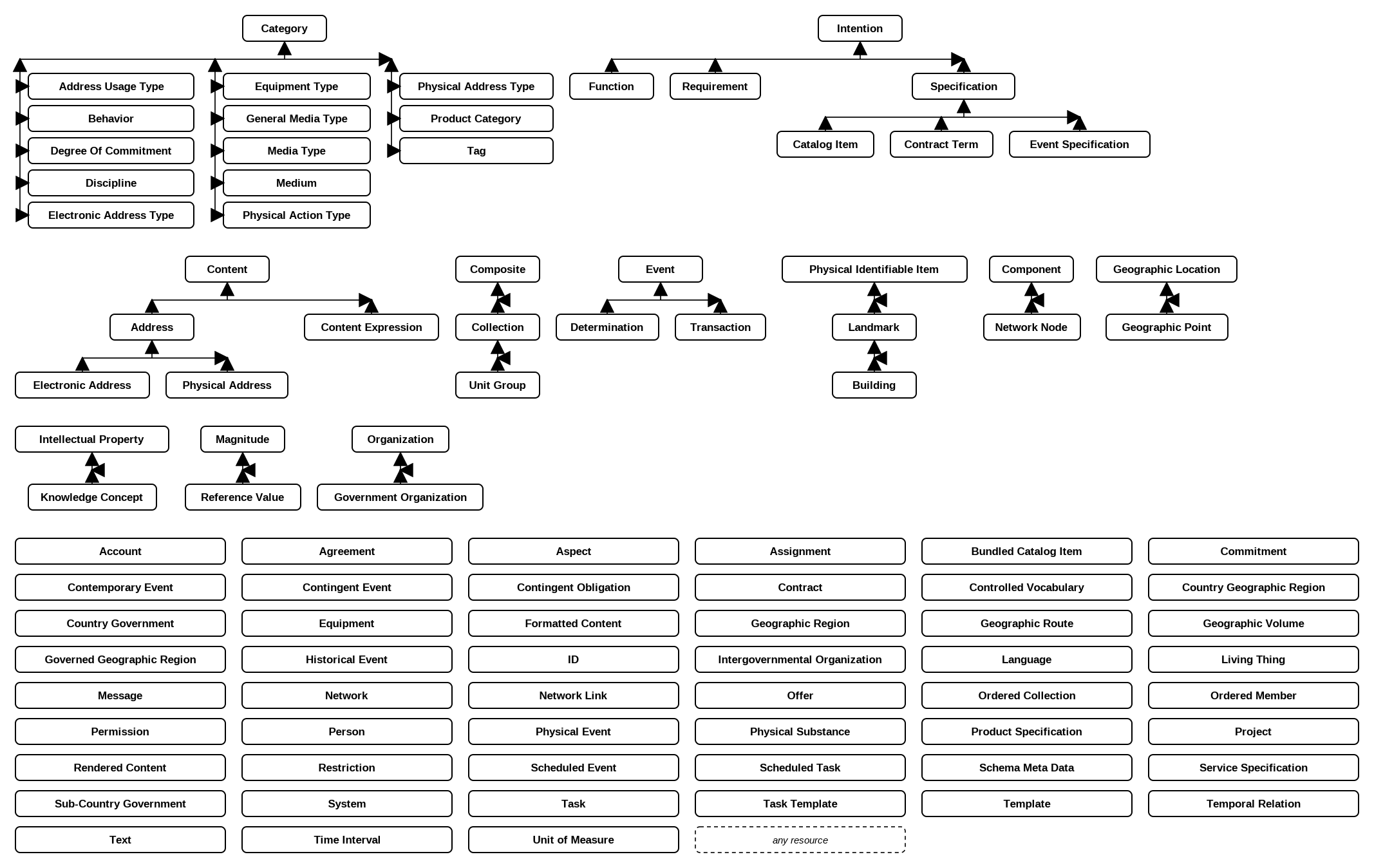
Classes
https://w3id.org/semanticarts/ns/ontology/gist/Accountlabel “Account”
An agreement having a balance.
- Equivalent to
- gist:Agreementand (gist:hasMagnitude some (gist:hasAspect value gistd:_Aspect_financial_balance))
More statements
- Example
- A bank account, a credit card account, an accounts receivable account.
https://w3id.org/semanticarts/ns/ontology/gist/Addresslabel “Address”
A reference to a place (real or virtual) that can be located by some routing algorithm and where messages or things can be sent or received.
- Subclass of
- gist:Content
- Subclasses
- gist:ElectronicAddress gist:PhysicalAddress
- Range of
- gist:comesFromPlace gist:goesToPlace gist:hasAddress
More statements
- Example
- A PO Box, a URL to a PDF file.
https://w3id.org/semanticarts/ns/ontology/gist/AddressUsageTypelabel “Address Usage Type”
A category indicating the context or manner in which an address may be used.
- Subclass of
- gist:Category
More statements
- Scope note
- If you are using temporal relations involving addresses, this category should be used to qualify the temporal relation rather than the address itself, since the same address may have different uses in different contexts, by different people and organizations, or at different times.
- Example
- Billing, business, personal, postal, residence.
https://w3id.org/semanticarts/ns/ontology/gist/Agreementlabel “Agreement”
A mutually understood arrangement in which two or more parties make commitments to one another.
- Equivalent to
- gist:Intentionand (gist:hasParty some (gist:Organization or gist:Person))and (inverse gist:isDirectPartOf min 2 gist:Commitment)
More statements
- Scope note
- While an agreement has two or more parties, and contains commitments which bind those parties, it will not always be necessary to instantiate each individual commitment.
- Example
- A gym membership is an agreement in which the member commits to paying the gym a certain price and the gym commits to allowing access to their facilities.
https://w3id.org/semanticarts/ns/ontology/gist/Aspectlabel “Aspect”
A measurable characteristic.
- Domain of
- gist:hasUnitGroup
- Range of
- gist:hasAspect
More statements
- Scope note
- Depending on implementation, every aspect should be related to a unit group either directly or through a broader aspect. For example, angle of incidence could be related to the broader concept of angle, which in turn is related to a unit group, or it could be related directly to the unit group without the hierarchical relationship.Rule of thumb: use the least specific aspect that serves the intended purpose, increasing specificity only when required (e.g., to distinguish between two magnitudes attached to the same object).
- Example
- Length, weight, cost, cycle time, defect rate, wheelbase, billing rate.
- Disjoint with
- gist:Event
https://w3id.org/semanticarts/ns/ontology/gist/Assignmentlabel “Assignment”
A temporal relationship between an assignee, the thing assigned, and the resource that made the assignment.
- Equivalent to
- gist:TemporalRelationand (gist:hasGiver some owl:Thing)and (gist:isAssignmentOf some owl:Thing)and (gist:isAssignmentTo some owl:Thing)
More statements
- Scope note
- Based on the Open World Assumption, the assigner may not be asserted or known.For some assignments, such as the assignment of a person to a task, it may seem equally correct in ordinary speech to say it is an assignment of a task to a person. Since gist:isAssignmentTo and gist:isAssignmentOf have no formal domains or ranges, the choice of which predicate to use for which is left as an implementation decision. Consistency is a key consideration.
- Example
- An employee is assigned to a task by a supervisor. A person is assigned to a position.
https://w3id.org/semanticarts/ns/ontology/gist/Behaviorlabel “Behavior”
A category indicating the nature of an activity.
- Subclass of
- gist:Category
- Range of
- gist:prevents gist:prohibits
More statements
- Example
- Drilling and cutting are two different kinds of manufacturing event.
https://w3id.org/semanticarts/ns/ontology/gist/Buildinglabel “Building”
A relatively permanent man-made structure situated on a plot of land, having a roof and walls, commonly used for dwelling, entertaining, or working.
- Subclass of
- gist:Landmark
More statements
- Scope note
- User discretion can be applied to edge cases: e.g., is a traditional yurt 'relatively permanently situated' although it is portable and has a tent-like construction?
- Example
- A house, school, store, factory, chicken coop.Negative examples: houseboats (not built on land), caves (not man-made), food trucks and RVs (not permanently situated).
- Deprecated
- true
https://w3id.org/semanticarts/ns/ontology/gist/BundledCatalogItemlabel “Bundled Catalog Item”
Any combination of descriptions of things offered together.
- Equivalent to
- gist:CatalogItemand (inverse gist:isDirectPartOf some gist:CatalogItem)
More statements
- Example
- A kit containing several parts offered together; a product plus a warranty.
https://w3id.org/semanticarts/ns/ontology/gist/CatalogItemlabel “Catalog Item”
A description of a product or service to be delivered, given in a sufficient level of detail that a receiver could determine whether delivery constituted discharge of the obligation to deliver.
- Subclass of
- gist:Specification
More statements
- Scope note
- In short, an unambiguous characterization of what it is that a potential buyer is paying for.
https://w3id.org/semanticarts/ns/ontology/gist/Categorylabel “Category”
A concept or label used to categorize other instances without specifying any formal semantics.
- Subclass of
- gist:isAllocatedBy some (gist:IntellectualProperty or gist:Organization or gist:Person)
- Subclasses
- gist:AddressUsageType gist:Behavior gist:DegreeOfCommitment gist:Discipline gist:ElectronicAddressType gist:EquipmentType gist:GeneralMediaType gist:MediaType gist:Medium gist:PhysicalActionType gist:PhysicalAddressType gist:ProductCategory gist:Tag
More statements
- Scope note
- Often a type can be modeled either as an owl:Class or as a gist:Category. Use the latter if you don't care much about the formal structure of the different types, or if there is a whole hierarchy of types that are going to be managed by a group separate from the ontology developers. The formal structure may be defined elsewhere and linked to, if necessary.
- Example
- Tags used in folksonomies; formal definitions from other systems.
- Disjoint with
- gist:Event
https://w3id.org/semanticarts/ns/ontology/gist/Collectionlabel “Collection”
A grouping of things.
- Subclass of
- gist:Composite
- Subclasses
- gist:UnitGroup
More statements
- Scope note
- Individuals are placed in the collection using the gist:isMemberOf property. Collections typically are created because the members are functionally connected in some way. This definition allows a collection to have zero members.
- Example
- A jury is a group of people; a financial ledger is a collection of transaction entries; a route is an (ordered) collection of segments.
https://w3id.org/semanticarts/ns/ontology/gist/Commitmentlabel “Commitment”
A promise made by a single party to one or more parties to do or not do something or act in a particular way.
- Equivalent to
- gist:Intentionand (gist:Requirement or gist:Restriction)and (gist:hasGiver some (gist:Organization or gist:Person))and (gist:isCategorizedBy some gist:DegreeOfCommitment)
More statements
- Scope note
- A commitment is unilateral in that it is binding on only one party. This contrasts with gist:Agreement, which consists of commitments that bind two or more parties.A single commitment may be made to multiple parties at once; it is a single commitment rather than multiple commitments if the same action would fulfill the obligation to all the parties simultaneously. For example, a performer makes a single commitment to hold a performance to all ticket purchasers; by holding the performance, the commitment to all parties is fulfilled in a single action.The manner in which a commitment is binding may vary. In a business context, we are typically interested in commitments that are legally binding.
- Example
- Upon selling a treasury bill, the U.S. government makes a commitment to pay the purchaser a stated amount of money at a stated time.When signing an NDA, the signatory commits to keeping specified information confidential.
https://w3id.org/semanticarts/ns/ontology/gist/Componentlabel “Component”
Something that, while having an independent existence, is inherently part of or designed to be part of a larger entity, such as a system or network.
- Subclasses
- gist:NetworkNode
More statements
- Scope note
- A component may be designed or intended as part of a whole without actually being so; e.g., a car steering wheel that is not installed in any car.Many things are in a trivial sense a part of a larger thing, but are not considered components because they are not inherently part of that larger thing. For example, while a book may be part of a library (a collection of books), it is not inherently so, and thus is not a component. A playing card, on the other hand, could be considered a component in (member of) a deck of cards. This may be use case-dependent; e.g., car parts might be modeled as components in an automobile manufacturing context but not in a retail auto parts store.Physical substances, such as ingredients in a cake batter, do not meet the independent existence criterion, so are not components.This class is not disjoint with gist:Composite, because a component may itself break down into smaller components.This is an abstract class that is not directly instantiated. Users will define subclasses that are meaningful to their domain of interest.
- Disjoint with
- gist:PhysicalSubstance
https://w3id.org/semanticarts/ns/ontology/gist/Compositelabel “Composite”
Something which is made up of various parts or elements that are independently identifiable.
- Subclasses
- gist:Collection
More statements
- Scope note
- Some composites, like systems, networks, and ordered collections, have internal organization, while others, such as unordered collections, typically do not.This class is not disjoint with gist:Component, because a composite can itself be a component of a larger composite.This is an abstract class that will not be directly instantiated.
- Example
- A library (collection of books); a network of pipes and valves; a computer network of routers and computers.
https://w3id.org/semanticarts/ns/ontology/gist/ContemporaryEventlabel “Contemporary Event”
An event that has started but has not yet ended.
- Equivalent to
- gist:Eventand (gist:actualEndDateTime max 0)and (gist:actualStartDateTime exactly 1)
More statements
- Scope note
- When the event actually ends, it will cease being contemporary.
https://w3id.org/semanticarts/ns/ontology/gist/Contentlabel “Content”
Information available in some medium.
- Subclasses
- gist:Address gist:ContentExpression
- Domain of
- gist:isAbout
More statements
- Scope note
- Categories are not content until they are written down.This class includes both abstract content and its expression, but it must have at least one expression in order to be content. For example, the idea a writer has for a book is not content until it is expressed in some form, but a single content object may have multiple expressions - e.g., the particular print and audio editions.
- Example
- The literary work 'The Adventures of Huckleberry Finn' by Mark Twain, independent of any particular edition.
- Disjoint with
- gist:GeoPointgist:GeoRegiongist:Organizationgist:PhysicalIdentifiableItemgist:PhysicalSubstancegist:UnitOfMeasure
https://w3id.org/semanticarts/ns/ontology/gist/ContentExpressionlabel “Content Expression”
Content reduced to text, audio, etc.
- Subclass of
- gist:Contentgist:isCategorizedBy some gist:GeneralMediaType
More statements
- Scope note
- If it contains text (written or spoken), it will be expressed in a language.While the content expression is less abstract than a 'Work,' it is more abstract than the specific physical items that render the expression. For example, any physical or electronic book with ISBN-13 978-1953649805 is associated with the same content expression.
- Example
- A specific print or audio edition of 'The Adventures of Huckleberry Finn,' such as the one identified by ISBN-13 978-1953649805.
https://w3id.org/semanticarts/ns/ontology/gist/ContingentEventlabel “Contingent Event”
An event with a probability of happening in the future, and usually dependent upon some other event or condition.
- Equivalent to
- gist:Eventand (gist:hasMagnitude some (gist:hasAspect value gistd:_Aspect_probability))and (gist:isTriggeredBy some gist:Event)
More statements
- Example
- A fire insurance payout is contingent on a particular building burning down; selling 20 shares of stock in a given company is contingent on the price dropping below $200/share; the death benefit payout on a life insurance policy is contingent on the death of the insured person.
ContingentObligation
classhttps://w3id.org/semanticarts/ns/ontology/gist/ContingentObligationlabel “Contingent Obligation”
An obligation that is not yet firm. There is some contingent event whose occurrence will cause the obligation to become firm.
- Equivalent to
- gist:Commitmentand (gist:hasGiver some (gist:Organization or gist:Person))and (gist:isTriggeredBy some gist:Event)
More statements
- Scope note
- A contingent obligation might have a getter counterparty (as in the case of insurance); but it might not (as in the case of an offer).
https://w3id.org/semanticarts/ns/ontology/gist/Contractlabel “Contract”
An agreement which can be enforced by law.
- Equivalent to
- gist:Agreementand (gist:isUnderJurisdictionOf some gist:GovernmentOrganization)
https://w3id.org/semanticarts/ns/ontology/gist/ContractTermlabel “Contract Term”
A specification of some aspect of a contract.
- Subclass of
- gist:Specification
ControlledVocabulary
classhttps://w3id.org/semanticarts/ns/ontology/gist/ControlledVocabularylabel “Controlled Vocabulary”
A collection of terms approved and managed by some organization or person.
- Equivalent to
- gist:Collectionand (gist:isGovernedBy some (gist:Organization or gist:Person))and (inverse gist:isMemberOf some gist:Category)
More statements
- Scope note
- A controlled vocabulary is similar to a skos:ConceptScheme, but it could also be used for things that are not concepts, such as organizations, US presidents, geographic regions, etc. Hierarchical relationships between instances of the controlled vocabulary are possible.
https://w3id.org/semanticarts/ns/ontology/gist/CountryGeoRegionlabel “Country Geographic Region”
A geographic region governed by exactly one country government.
- Subclass of
- gist:isGovernedBy exactly 1
- Equivalent to
- gist:GovernedGeoRegionand (gist:isGovernedBy some gist:CountryGovernment)
https://w3id.org/semanticarts/ns/ontology/gist/CountryGovernmentlabel “Country Government”
A government organization which asserts both sovereignty (i.e., it is not governed by some other government organization) and governance over an entity generally recognized as a country.
- Subclass of
- gist:isGovernedBy max 0 gist:GovernmentOrganizationinverse gist:isGovernedBy exactly 1 gist:CountryGeoRegion
- Equivalent to
- gist:GovernmentOrganizationand (inverse gist:isGovernedBy some gist:CountryGeoRegion)
More statements
- Scope note
- While a country government may enter into treaties with other country governments, there are no governing relationships among the treaty members.
- Disjoint with
- gist:SubCountryGovernment
https://w3id.org/semanticarts/ns/ontology/gist/DegreeOfCommitmentlabel “Degree Of Commitment”
The difficulty of reversing a commitment.
- Subclass of
- gist:Category
More statements
- Example
- A car rental typically has a lower degree of commitment than an airfare reservation.
https://w3id.org/semanticarts/ns/ontology/gist/Determinationlabel “Determination”
An event whose purpose is to establish a specific result, value, or outcome, usually by research, measuring, evaluating, or calculating.
- Subclass of
- gist:Event
More statements
- Example
- Measuring the sulfur content of crude oil; evaluating a loan application for approval; estimating the price of gas for the next three months; determining whether and by how much an interest rate should change; classifying a purchase into a budget category.
https://w3id.org/semanticarts/ns/ontology/gist/Disciplinelabel “Discipline”
An area of study or practice.
- Subclass of
- gist:Category
More statements
- Example
- Finance, accounting, project management, acoustics, ballistics.
https://w3id.org/semanticarts/ns/ontology/gist/ElectronicAddresslabel “Electronic Address”
An address referring to a locatable virtual place that does not physically exist but is made by software or electronics to appear to do so.
- Subclass of
- gist:Address
More statements
- Alternative label
- Virtual Address
- Example
- A file system path, website URL, IP address, email address, mobile or landline telephone number.
- Disjoint with
- gist:PhysicalAddress
ElectronicAddressType
classhttps://w3id.org/semanticarts/ns/ontology/gist/ElectronicAddressTypelabel “Electronic Address Type”
A category indicating a kind of electronic address. Such a category is usually based on the technology that enables routing to the address referent.
- Subclass of
- gist:Category
More statements
- Example
- A URL, file system path, email address, mobile telephone number.
https://w3id.org/semanticarts/ns/ontology/gist/Equipmentlabel “Equipment”
Human-made, tangible property other than land or buildings used to perform a task or activity.
- Equivalent to
- gist:PhysicalIdentifiableItemand (gist:isCategorizedBy some gist:EquipmentType)
More statements
- Example
- A machine, a router, a car, a baseball bat.
https://w3id.org/semanticarts/ns/ontology/gist/EquipmentTypelabel “Equipment Type”
A category of equipment.
- Subclass of
- gist:Category
https://w3id.org/semanticarts/ns/ontology/gist/Eventlabel “Event”
Something that occurs over a period of time, often characterized as an activity being carried out by some person, organization, or software application or brought about by natural forces.
- Subclasses
- gist:Determination gist:Transaction
More statements
- Scope note
- An event does not necessarily have either planned or actual start or end datetimes. For example, a conference can be in the planning phase without any dates selected, but is nevertheless an (unscheduled) event. The subclasses of gist:Event state particular restrictions on planned and actual start and end dates.An event occurs during a time interval, which is distinct from the event.
- Example
- A transaction, conference, baseball game, earthquake.
- Disjoint with
- gist:Languagegist:Magnitudegist:TimeIntervalgist:UnitOfMeasure
https://w3id.org/semanticarts/ns/ontology/gist/EventSpecificationlabel “Event Specification”
A characterization of an event that might happen.
- Subclass of
- gist:Specification
More statements
- Scope note
- This concept is useful for risk assessment and insurance policies.
- Example
- An insurance company defines the characteristics of a weather event that must be satisfied for it to qualify as a hail storm covered in its homeowner's policy; a bank defines the point at which a borrower defaults on a loan.
https://w3id.org/semanticarts/ns/ontology/gist/FormattedContentlabel “Formatted Content”
Content encoded in a specific format, but existing as data independent of any particular physical medium.
- Equivalent to
- gist:ContentExpressionand (gist:isExpressedIn some gist:MediaType)
More statements
- Scope note
- Each instance of formatted content is a distinct formatting of some Content. Thus, a PDF-formatted version and an HTML-formatted version of the same content are separate instances of formatted content.
- Example
- A document in PDF format; an image in JPEG format.
https://w3id.org/semanticarts/ns/ontology/gist/Functionlabel “Function”
The activity that a human-made item is intended to perform.
- Subclass of
- gist:Intention
More statements
- Example
- Transmit electricity, provide ballast, control ambient temperature.
https://w3id.org/semanticarts/ns/ontology/gist/GeneralMediaTypelabel “General Media Type”
The real-world media type for content.
- Subclass of
- gist:Category
More statements
- Example
- Audio, still image, video, textual, physical (e.g., a statue), performance (e.g., a play), oil or pastel for a painting.
https://w3id.org/semanticarts/ns/ontology/gist/GeoLocationlabel “Geographic Location”
A physical location, with the earth as a frame of reference.
- Subclasses
- gist:GeoPoint
- Domain of
- gist:isGeoContainedIn
- Range of
- gist:comesFromPlace gist:goesToPlace gist:hasPhysicalLocation gist:isGeoContainedIn
More statements
- Scope note
- A geographic location may be a point, region, or volume.
https://w3id.org/semanticarts/ns/ontology/gist/GeoPointlabel “Geographic Point”
An individual point on or above the Earth's surface, identified by latitude, longitude and altitude. Altitude is the distance measured from sea level. If altitude is missing, the point is assumed to be at the Earth's surface. These points are described using decimal latitude/longitude.
- Subclass of
- gist:GeoLocation
- Equivalent to
- (gist:hasMagnitude some (gist:hasAspect value gistd:_Aspect_altitude))and (gist:latitude some xsd:double)and (gist:longitude some xsd:double)
- Domain of
- gist:latitude gist:longitude
More statements
- Disjoint with
- gist:IntellectualPropertygist:Intentiongist:Languagegist:Magnitudegist:Organizationgist:PhysicalIdentifiableItemgist:PhysicalSubstancegist:UnitOfMeasure
https://w3id.org/semanticarts/ns/ontology/gist/GeoRegionlabel “Geographic Region”
A bounded region (or set of regions) on the surface of the Earth.
- Subclass of
- gist:GeoLocationand (gist:hasMagnitude some (gist:hasAspect value gistd:_Aspect_area))
More statements
- Scope note
- A geographic region could be non-contiguous; e.g., the region governed by the US federal government is the contiguous area of the lower 48 states plus Alaska, Hawaii, and overseas territories. Child classes in lower ontologies can make this distinction.
- Example
- The bounded shape that defines the region occupied by Crater Lake; the bounded area known as the contiguous USA.
- Disjoint with
- gist:IntellectualPropertygist:Intentiongist:Languagegist:Magnitudegist:Organizationgist:PhysicalIdentifiableItemgist:PhysicalSubstancegist:Templategist:UnitOfMeasure
https://w3id.org/semanticarts/ns/ontology/gist/GeoRoutelabel “Geographic Route”
An ordered set of geographic points that defines a path from a starting point to an ending point.
- Equivalent to
- gist:OrderedCollectionand (inverse gist:isMemberOf some gist:GeoPoint)
More statements
- Scope note
- A geographic route could describe a bus route by identifying the points where the bus stops. A geographic route could describe the boundary of a polygonal geographic region (it does not have to be a traveled route).
https://w3id.org/semanticarts/ns/ontology/gist/GeoVolumelabel “Geographic Volume”
A three-dimensional space on or near the surface of the Earth.
- Equivalent to
- gist:GeoLocationand (gist:hasMagnitude some (gist:hasAspect value gistd:_Aspect_volume))and (inverse gist:isGeoContainedIn some gist:GeoPoint)
More statements
- Example
- An oil reservoir, the body of a lake, or an airspace.
https://w3id.org/semanticarts/ns/ontology/gist/GovernedGeoRegionlabel “Governed Geographic Region”
A geographic region governed by at least one government organization.
- Equivalent to
- gist:GeoRegionand (gist:isGovernedBy some gist:GovernmentOrganization)
More statements
- Scope note
- Geographic regions do not need not be physically contiguous in order to constitute a governed geographic region; e.g., Alaska and Hawaii are part of the region governed by the United States.
GovernmentOrganization
classhttps://w3id.org/semanticarts/ns/ontology/gist/GovernmentOrganizationlabel “Government Organization”
An independent organization exercising political and/or regulatory authority over a political unit, people, geographical region, etc., as well as performing certain functions for this unit or body.
- Subclass of
- gist:Organization
More statements
- Scope note
- Includes administrative, regulatory, and enforcement organizations created or sanctioned by country or sub-country governments.
- Example
- Negative example: A corporation, which is owned and therefore not independent.The State of Washington Office of Financial Management; the Food and Drug Administration; the Scottish Parliament.
- Disjoint with
- gist:IntergovernmentalOrganization
https://w3id.org/semanticarts/ns/ontology/gist/HistoricalEventlabel “Historical Event”
An event which occurred in time, with an actual end earlier than the present moment.
- Subclass of
- gist:actualStartDateTime some xsd:dateTime
- Equivalent to
- gist:Eventand (gist:actualEndDateTime some xsd:dateTime)
https://w3id.org/semanticarts/ns/ontology/gist/IDlabel “ID”
Content that is used to uniquely identify something or someone.
- Equivalent to
- gist:Contentand (gist:isAllocatedBy some (gist:IntellectualProperty or gist:Organization or gist:Person))and (gist:uniqueText some xsd:string)
- Range of
- gist:isIdentifiedBy
More statements
- Scope note
- Used in conjunction with gist:isIdentifiedBy.
- Example
- SSN for a person; serial number for a product; employee ID for a person.
IntellectualProperty
classhttps://w3id.org/semanticarts/ns/ontology/gist/IntellectualPropertylabel “Intellectual Property”
An intangible work, invention, or concept, independent of its being expressed in text, audio, video, image, or live performance. IP can also be tacit knowledge, know-how, or skill.
- Subclasses
- gist:KnowledgeConcept
- Range of
- gist:isAllocatedBy
More statements
- Scope note
- For literature this could be called the 'Work,' except that 'work' is a highly overloaded term (expenditure of energy, resource consumption, art). Often the first expression precedes our recognition of the IP, but subsequent expressions are known to be derivatives of the IP, even if they are expression-to-expression translations (or copies).This concept includes works that are out of copyright or were never formally registered; the defining feature is not that it is legally protected but that it is an intangible creation of the human mind.
- Example
- The Old Man and The Sea; the Page Rank algorithm; the brand Coca Cola.
- Disjoint with
- gist:Magnitudegist:Organizationgist:PhysicalIdentifiableItemgist:PhysicalSubstancegist:UnitOfMeasure
https://w3id.org/semanticarts/ns/ontology/gist/Intentionlabel “Intention”
A goal, desire, or aspiration.
- Subclasses
- gist:Function gist:Requirement gist:Specification
- Domain of
- gist:prevents gist:prohibits
More statements
- Scope note
- The 'teleological' aspect of a system that indicates things are done with a purpose.
- Disjoint with
- gist:Magnitudegist:Organizationgist:PhysicalIdentifiableItemgist:PhysicalSubstancegist:UnitOfMeasure
IntergovernmentalOrganization
classhttps://w3id.org/semanticarts/ns/ontology/gist/IntergovernmentalOrganizationlabel “Intergovernmental Organization”
An organization whose members are government organizations. This can comprise regional, municipal, state/province, or national level entities.
- Equivalent to
- gist:Organizationand (inverse gist:isMemberOf min 2 gist:GovernmentOrganization)
More statements
- Example
- The United Nations, the European Union, the Metropolitan Transit Authority.
https://w3id.org/semanticarts/ns/ontology/gist/KnowledgeConceptlabel “Knowledge Concept”
An abstract concept that arises from the distillation of experience. It is similar to a category but, rather than being a simple tag, it has rich structure.
- Subclass of
- gist:IntellectualProperty
More statements
- Scope note
- Some knowledge is about specific instances that already exist in the knowledge graph. We may have knowledge that Judge Jones is more lenient on repeat offenders in the morning; we may know that the earliest killing frost in Fort Collins is the last week of September.
These fit the broader definition of knowledge, the distillation of experience. But they do not require any new instances. Judge Jones and Fort Collins already exist and have a place in our knowledge graph.
But some knowledge requires that we synthesize new instances in order to have a place to consolidate the knowledge. A disease isn't a tangible thing, like a person or a building. A disease is a prediction that a person's health will decline in a predictable way (without treatment and with treatment). The number of diseases continues to grow as we collectively learn more and more granular distinctions. Lung cancer used to be a single disease, but now we have dozens of fine-grained distinctions; e.g., non-lymphoma small cell fusiform is different from alveolar adenocarcinoma because we now know the prognosis and treatment are different.
This superclass is meant as a place for subclasses that will have the instances that represent the foci of the knowledge we have acquired. Note the distinction between a particular portion of, say, gold, which instantiates gist:PhysicalSubstance, and the concept of gold, which instantiates gist:KnowledgeConcept.
In some ontologies what we are calling knowledge concepts are defined as classes; e.g., non-lymphoma small cell fusiform and alveolar adenocarcinoma would be two classes rather than two instances. But using a class makes it harder to connect the concept to other instances in a knowledge graph, and furthermore such classes would lack instances.
- Example
- Most domains will define a few subclasses, such as gene, protein, chemical, disease, subject matter, industry, method.
https://w3id.org/semanticarts/ns/ontology/gist/Landmarklabel “Landmark”
Something permanently attached to the Earth.
- Subclass of
- gist:PhysicalIdentifiableItemgist:hasPhysicalLocation some (gist:GeoRegion or gist:GeoVolume)
- Subclasses
- gist:Building
More statements
- Editorial note
- See guidance on removing the term in the next major release at https://github.com/semanticarts/gist/issues/947#issuecomment-1679566885.
- Deprecated
- true
https://w3id.org/semanticarts/ns/ontology/gist/Languagelabel “Language”
A recognized, organized set of symbols and grammar.
More statements
- Example
- Natural languages such as English and Spanish; computer languages such as OWL, Python, and XML.
- Disjoint with
- gist:Magnitudegist:Organizationgist:PhysicalIdentifiableItemgist:PhysicalSubstancegist:UnitOfMeasure
- Deprecated
- true
https://w3id.org/semanticarts/ns/ontology/gist/LivingThinglabel “Living Thing”
Something that is currently, or at some point in time was, alive.
- Equivalent to
- gist:PhysicalIdentifiableItemand (gist:birthDate exactly 1)and (gist:hasBiologicalParent some gist:LivingThing)
- Domain of
- gist:hasBiologicalParent
- Range of
- gist:hasBiologicalParent
More statements
- Scope note
- Not all life forms have exactly two parents, so the restriction only specifies a minimum of one.
- Example
- A cat, a mushroom, a tree.Negative examples: fictional life forms such as unicorns or Mickey Mouse.
https://w3id.org/semanticarts/ns/ontology/gist/Magnitudelabel “Magnitude”
The amount of a measurable characteristic (aspect).
- Equivalent to
- (gist:hasAspect some gist:Aspect)and (gist:hasUnitOfMeasure some gist:UnitOfMeasure)and (gist:numericValue some rdfs:Literal)
- Subclasses
- gist:ReferenceValue
- Domain of
- gist:hasUnitOfMeasure
- Range of
- gist:hasAccuracy gist:hasMagnitude
More statements
- Scope note
- An accuracy can be assigned to a magnitude using the property has accuracy.
- See also
- gist:hasAccuracy
- Example
- A model of car could have a wheelbase of 113.2 inches. In this example, the aspect is wheelbase, the unit of measure is inch, and the numeric value is 113.2.
- Disjoint with
- gist:Organizationgist:PhysicalIdentifiableItemgist:PhysicalSubstancegist:UnitOfMeasure
https://w3id.org/semanticarts/ns/ontology/gist/MediaTypelabel “Media Type”
A digitized type that computer applications can recognize.
- Subclass of
- gist:Categorygist:uniqueText some xsd:string
More statements
- Scope note
- The unique text for an IANA media type is the concatenation of the 'Type name', a slash '/', and the 'Subtype name' as provided on the page displayed when you resolve the URI of the media type.
- See also
- https://www.iana.org/assignments/media-types/media-types.xhtml
- Example
- application/sparql-results+xml
https://w3id.org/semanticarts/ns/ontology/gist/Mediumlabel “Medium”
A physical material on which a work can be rendered, represented, or implemented.
- Subclass of
- gist:Category
More statements
- Example
- Paper, clay, a computer monitor.
https://w3id.org/semanticarts/ns/ontology/gist/Messagelabel “Message”
A specific instance of content sent from a sender to at least one other recipient.
- Equivalent to
- gist:ContentExpressionand (gist:comesFromAgent some (gist:Organization or gist:Person))and (gist:goesToAgent some (gist:Organization or gist:Person))
More statements
- Example
- An email, voice, or web service message; a phone call.
https://w3id.org/semanticarts/ns/ontology/gist/Networklabel “Network”
A composite consisting of nodes connected by links.
- Equivalent to
- gist:Compositeand (inverse gist:isMemberOf some (gist:NetworkLink or gist:NetworkNode))
More statements
- Example
- A physical network could include connected computers or routers, whereas a social network would consist of related person or organization members (or their proxies, such as accounts).
https://w3id.org/semanticarts/ns/ontology/gist/NetworkLinklabel “Network Link”
An abstract representation of the connection between two or more nodes in a network.
- Subclass of
- gist:links exactly 2gist:links only gist:NetworkNode
- Equivalent to
- gist:Componentand (gist:isMemberOf some gist:Network)and (gist:links some gist:NetworkNode)
More statements
- Scope note
- Each network link is connected to a network node via the property gist:links or one of its subproperties.
- Example
- A network link may be physical, such as pipes, wired or wireless networks, but may also be a link in a non-physical network, such as organizational structures or social networks.
https://w3id.org/semanticarts/ns/ontology/gist/NetworkNodelabel “Network Node”
A node in a network.
- Subclass of
- gist:Componentgist:isMemberOf some gist:Network
More statements
- Example
- A person's account is a node in a social network; a valve is a node in a network of pipes.
https://w3id.org/semanticarts/ns/ontology/gist/Offerlabel “Offer”
A contingent commitment to buy, sell, swap or provide one or more described or identified goods or services in exchange for another (or others).
- Equivalent to
- gist:ContingentObligationand (gist:hasGiver some (gist:Organization or gist:Person))and (gist:offersToProvide some owl:Thing)and (gist:offersToReceive some owl:Thing)and (gist:plannedEndDateTime some xsd:dateTime)and (gist:plannedStartDateTime some xsd:dateTime)
More statements
- Scope note
- Dates on an offer represent the time period the offer is valid for, as in '25% off through October 25, 2025.'
- Example
- An offer to sell a book for a given price; an offer to purchase real estate for a particular price; an offer to swap a sea kayak for a mountain bike; currency exchange. A donation may be modeled as an offer to receive money typically in exchange for $0.00, but sometimes for items of value such as coffee mugs or T-shirts.
https://w3id.org/semanticarts/ns/ontology/gist/OrderedCollectionlabel “Ordered Collection”
A collection whose members are ordered in some way.
- Equivalent to
- gist:Collectionand ((inverse gist:isFirstMemberOf some gist:OrderedMember) or (inverse gist:isMemberOf exactly 0))and (inverse gist:isMemberOf only gist:OrderedMember)
- Range of
- gist:isFirstMemberOf
More statements
- Scope note
- Includes partially ordered collections as well as collections in which members occupy the same position in a 'tie.' All members of an ordered collection are ordered members.
https://w3id.org/semanticarts/ns/ontology/gist/OrderedMemberlabel “Ordered Member”
A member of an ordered collection serving as a proxy for a real world item, which can appear in different orders in different collections. The ordered member appears in exactly one ordered collection.
- Equivalent to
- gist:Componentand ((gist:precedesDirectly some gist:OrderedMember) or (inverse gist:precedesDirectly some gist:OrderedMember) or (gist:sequence some xsd:integer))and (gist:isMemberOf exactly 1)and (gist:isMemberOf only gist:OrderedCollection)and (gist:providesOrderFor some owl:Thing)
- Domain of
- gist:isFirstMemberOf gist:providesOrderFor
More statements
- Scope note
- An ordered member points to the real world item via the providesOrderFor property. Ordering information is represented either as a number in a sequence, or by preceding or following another ordered member.
- Example
- A person may rank 12th in the Boston Marathon but 29th in the New York City Marathon.
https://w3id.org/semanticarts/ns/ontology/gist/Organizationlabel “Organization”
A structured entity formed to achieve specific goals, typically involving members with defined roles.
- Subclasses
- gist:GovernmentOrganization
- Domain of
- gist:owns
- Range of
- gist:comesFromAgent gist:goesToAgent gist:hasParty gist:isAllocatedBy gist:isRecognizedBy
More statements
- Scope note
- Not all organizations have members, e.g. shell companies.While typically the members of organizations are people, in some cases they are other organizations; e.g., the members of the United Nations are country governments.
- Example
- Legal entities like companies; non-legal entities like clubs, committees, or departments.
- Disjoint with
- gist:PhysicalIdentifiableItemgist:PhysicalSubstancegist:SchemaMetaDatagist:UnitOfMeasure
https://w3id.org/semanticarts/ns/ontology/gist/Permissionlabel “Permission”
A description of things one is permitted to do.
- Equivalent to
- gist:Intentionand (gist:allows some gist:Behavior)
More statements
- Example
- Permission could be broad, such as free speech, but more often is very specific, such as the right to enter a particular property.
https://w3id.org/semanticarts/ns/ontology/gist/Personlabel “Person”
A human being who was or is alive.
- Subclass of
- gist:hasBiologicalParent only gist:Person
- Equivalent to
- gist:LivingThingand (gist:hasBiologicalParent some gist:Person)
- Domain of
- gist:owns
- Range of
- gist:comesFromAgent gist:goesToAgent gist:hasParty gist:isAllocatedBy gist:isRecognizedBy
More statements
- Example
- Negative example: fictional characters.
https://w3id.org/semanticarts/ns/ontology/gist/PhysicalActionTypelabel “Physical Action Type”
A category indicating the type of an action based on its effect in the physical world.
- Subclass of
- gist:Category
More statements
- Example
- Lifting a garage door, turning off a valve, dropping cadmium rods.
https://w3id.org/semanticarts/ns/ontology/gist/PhysicalAddresslabel “Physical Address”
An address that refers to a locatable place within the physical universe.
- Subclass of
- gist:Address
- Equivalent to
- gist:Addressand (gist:refersTo some gist:GeoLocation)
More statements
- Example
- 1600 Pennsylvania Avenue NW, Washington, DC 20500; PO Box 7704, San Francisco, CA 94120-7704; Room 317 in the Louvre Museum.
https://w3id.org/semanticarts/ns/ontology/gist/PhysicalAddressTypelabel “Physical Address Type”
A category indicating local customary characterizations of physical addresses.
- Subclass of
- gist:Category
More statements
- Example
- Street address, PO box, FPO code.
https://w3id.org/semanticarts/ns/ontology/gist/PhysicalEventlabel “Physical Event”
An event that can be said to have occurred at some place in space.
- Equivalent to
- gist:Eventand (gist:occursIn some gist:GeoLocation)
More statements
- Example
- A meeting, a car accident.Negative examples: Excludes events that have no meaningful location, such as financial events or project milestones.
PhysicalIdentifiableItem
classhttps://w3id.org/semanticarts/ns/ontology/gist/PhysicalIdentifiableItemlabel “Physical Identifiable Item”
A discrete physical object which, if subdivided, will result in parts that are distinguishable in nature from the whole and in general also from the other parts.
- Subclass of
- gist:hasMagnitude some (gist:hasAspect value gistd:_Aspect_mass)gist:hasMagnitude some (gist:hasAspect value gistd:_Aspect_volume)gist:isMadeUpOf some gist:PhysicalSubstance
- Subclasses
- gist:Landmark
More statements
- Scope note
- This concept generally corresponds to count nouns in English. By contrast, physical substances, such as an amount of water, flour, or sand, are mass nouns. Physical identifiable items are made up of physical substances; e.g., a cake is made up of butter, flour, and sugar; a statue is made of bronze. If you divide a physical substance such as an amount of water into parts, you have two amounts of water otherwise indistinguishable from one another; if you divide a physical identifiable item such as a computer into parts, each part is different from the whole.
- Example
- A laptop, a physical book, a car, a building, a landmark (such as a tree stump with an etched marking to denote a campsite).
- Disjoint with
- gist:SchemaMetaDatagist:UnitOfMeasure
https://w3id.org/semanticarts/ns/ontology/gist/PhysicalSubstancelabel “Physical Substance”
An undifferentiated amount of physical material which, when subdivided, results in each part being indistinguishable in nature from the whole and from every other part.
- Subclass of
- gist:hasMagnitude some (gist:hasAspect value gistd:_Aspect_mass)gist:hasMagnitude some (gist:hasAspect value gistd:_Aspect_volume)
- Range of
- gist:isMadeUpOf
More statements
- Scope note
- An instance of this class has weight and takes up space. We mean the physical gold in a ring, not the concept of gold that shows up in the periodic table. The latter would be an instance of gist:KnowledgeConcept.This concept generally corresponds to mass nouns in English. By contrast, instances of gist:PhysicalIdentifiableItem, such as a computer, book, or car, are count nouns. Physical identifiable items are made up of physical substances; e.g., a cake is made up of butter, flour, and sugar; a ring is made of gold. If you divide a physical substance such as an amount of water into parts, you have different amounts of water otherwise indistinguishable from one another; if you divide a physical identifiable item such as a computer into parts, each part will be distinguishable from the original whole.
- Example
- An amount of water, penicillin, sand, or gold.Negative example: the concept of gold.
- Disjoint with
- gist:UnitOfMeasure
https://w3id.org/semanticarts/ns/ontology/gist/ProductCategorylabel “Product Category”
Any of many ways of categorizing products.
- Subclass of
- gist:Category
More statements
- Example
- Automobile models, NATO product codes.
ProductSpecification
classhttps://w3id.org/semanticarts/ns/ontology/gist/ProductSpecificationlabel “Product Specification”
A description of something that could be physically warehoused or digitally stored and physically or digitally delivered.
- Equivalent to
- gist:CatalogItemand (gist:isCategorizedBy some gist:ProductCategory)
https://w3id.org/semanticarts/ns/ontology/gist/Projectlabel “Project”
A task, usually of longer duration, made up of other tasks.
- Equivalent to
- gist:Taskand (inverse gist:isPartOf some gist:Task)
More statements
- Example
- Designing an insurance product; adding a new feature to a software application; assessing the level of risk for a mortgage application.
https://w3id.org/semanticarts/ns/ontology/gist/ReferenceValuelabel “Reference Value”
A magnitude that was neither measured nor estimated but set by fiat.
- Subclass of
- gist:Magnitude
More statements
- Example
- The sales goal for a company.
https://w3id.org/semanticarts/ns/ontology/gist/RenderedContentlabel “Rendered Content”
Content expressed via some physical medium.
- Equivalent to
- gist:FormattedContentand (gist:isRenderedOn some gist:Medium)
More statements
- Scope note
- Renderings of the same file on two different monitors are separate instances of rendered content.
- Example
- Words printed on paper; audio played on speakers; an image displayed on a monitor; an original painting.
https://w3id.org/semanticarts/ns/ontology/gist/Requirementlabel “Requirement”
The obligation of a person or organization to behave in a certain way.
- Subclass of
- gist:Intention
More statements
- Example
- In the US, drivers must drive on the right side of the road.
https://w3id.org/semanticarts/ns/ontology/gist/Restrictionlabel “Restriction”
A description of things one is prevented from doing.
- Equivalent to
- gist:Intentionand (gist:prevents some gist:Behavior)
More statements
- Example
- In the US, tax laws restrict the amount of money a person can put in retirement accounts over the course of a year.
https://w3id.org/semanticarts/ns/ontology/gist/ScheduledEventlabel “Scheduled Event”
An event with a planned start datetime.
- Equivalent to
- gist:Eventand (gist:plannedStartDateTime some xsd:dateTime)
More statements
- Scope note
- If the event already started, but has not yet ended, it is a contemporary event with an actual start datetime. If the event is over, it is a historical event having an actual end datetime. The event always retains its planned start datetime, and thus continues to be a scheduled event.
https://w3id.org/semanticarts/ns/ontology/gist/ScheduledTasklabel “Scheduled Task”
A task with a planned start datetime.
- Equivalent to
- gist:ScheduledEventand gist:Task
More statements
- Scope note
- If work on the task has already started, but has not yet ended, it will have an actual start datetime. If the task is completed, it will also have an actual end datetime. The task always retains its planned start time, and thus continues to be a scheduled task.
https://w3id.org/semanticarts/ns/ontology/gist/SchemaMetaDatalabel “Schema Meta Data”
Superclass for all types of metadata.
More statements
- Scope note
- The definition of this class needs additional work.
- Example
- Relational concepts, such as tables and columns; tool inputs, such as queries and R2RML maps.
- Disjoint with
- gist:UnitOfMeasure
- Deprecated
- true
ServiceSpecification
classhttps://w3id.org/semanticarts/ns/ontology/gist/ServiceSpecificationlabel “Service Specification”
A description of something that can be done for a person or organization (which produces some form of an act).
- Equivalent to
- gist:CatalogItemand (inverse gist:isBasedOn some gist:Event)
https://w3id.org/semanticarts/ns/ontology/gist/Specificationlabel “Specification”
The set of characteristics and constraints on their values that specify what it means to be a particular type of thing, such as a material, product, service or event. A specification is sufficiently precise to allow evaluating conformance to the specification.
- Subclass of
- gist:Intention
- Subclasses
- gist:CatalogItem gist:ContractTerm gist:EventSpecification
More statements
- Scope note
- Although a characterization of how to do something is often called a specification, the intended meaning here is limited to specifying what something is. The focus is on the what, not the how. Use gist:TaskTemplate for specifying the how, such as a plan or process specification. Use gist:conformsTo to assert that something conforms to a specification. To represent a definition of a particular type of thing that is not sufficiently precise to be a gist:Specification, consider using gist:KnowledgeConcept.
- Example
- The specification of the iPhone 14; hypothetical events covered by a homeowner's insurance policy; a drug quality specification - a set of acceptance criteria for quality characteristics that must be controlled to ensure a drug is fit for its intended use.
SubCountryGovernment
classhttps://w3id.org/semanticarts/ns/ontology/gist/SubCountryGovernmentlabel “Sub-Country Government”
The government of a governed geographic region other than a country which is under the direct or indirect control of a country government.
- Equivalent to
- gist:GovernmentOrganizationand (gist:isGovernedBy some gist:CountryGovernment)and (inverse gist:isGovernedBy some gist:GeoRegion)
More statements
- Scope note
- Note that the predicate gist:isGovernedBy is used both for the relationship a governed geographic region has to its government and for the relationship a sub-region government has to the government of the larger region.There are many types of sub-regions of a country and the governments thereof (as well as different terms, like 'province' and 'state,' which refer to essentially the same type of thing). We should not automatically assume 'state,' 'county,' and 'city.' Subclasses or categories can be defined if greater specificity is needed.This class applies only to organizations governing geographic regions. Regulatory and bureaucratic organizations are members of the more generic gist:GovernmentOrganization class.
https://w3id.org/semanticarts/ns/ontology/gist/Systemlabel “System”
A composite made up of interacting or interdependent components that together operate as a whole.
- Equivalent to
- gist:Compositeand (inverse gist:isDirectPartOf some gist:Component)
More statements
- Scope note
- May be used to refer to either man-made or natural systems.
- Example
- A manufacturing system, a storm system.
https://w3id.org/semanticarts/ns/ontology/gist/Taglabel “Tag”
A term in a folksonomy used to categorize things. Tags can be made up on the fly by users.
- Subclass of
- gist:Categorygist:containedText some xsd:string
More statements
- Scope note
- Whether to use gist:containedText or gist:uniqueText on tags is an implementation decision. Since the latter is a subproperty of the former, the restriction remains valid either way.
https://w3id.org/semanticarts/ns/ontology/gist/Tasklabel “Task”
An activity or piece of work that is either proposed, planned, scheduled, underway, or completed.
- Equivalent to
- gist:Eventand (gist:hasGoal some gist:Intention)
More statements
- Scope note
- Something that could potentially be executed, which is merely described but not proposed in any specific way, such as a business process for onboarding a new employee, or the steps in a recipe for making polyethylene from ethylene, is not a task but rather a task template.This term is broader than the English word 'task,' which implies assignment, responsibility, or duty. In ordinary English going to a concert has a goal but is (generally) done for pleasure rather than out of obligation, and would not be considered a task, while according to the gist definition it is a task. The expansion of meaning is deliberate, so that anything that has a goal and can be specified by a task template is a task.Use the property gist:isBasedOn to link a task back to the task template.
https://w3id.org/semanticarts/ns/ontology/gist/TaskTemplatelabel “Task Template”
An outline of a task of a particular type, which is the basis for executing such tasks.
- Equivalent to
- gist:Templateand (gist:hasGoal some gist:Intention)
More statements
- Scope note
- A task template may define a single activity or a series of activities; the level of granularity can be varied according to use case. For example, in a new employee onboarding process, signing up for benefits might be one activity, or it might be broken down into signing up for health insurance, signing up for dental insurance, etc.Use the property isBasedOn to link the Task back to the TaskTemplate.
- Example
- A business process for onboarding new employees.
https://w3id.org/semanticarts/ns/ontology/gist/Templatelabel “Template”
Something used to make objects in its own image.
More statements
- Scope note
- Use gist:isBasedOn to link the object made from the template back to the template.
- Example
- A die in manufacturing is used to make stamped parts; a form provides a structure and fields to be filled in; a cookie cutter is a template for cookies.
- Disjoint with
- gist:UnitOfMeasure
https://w3id.org/semanticarts/ns/ontology/gist/TemporalRelationlabel “Temporal Relation”
A relationship existing for a period of time.
- Subclass of
- gist:hasParticipant min 2gist:startDateTime exactly 1
More statements
- Scope note
- A temporal relation must have a minimum of two participants. For example, both the employer and the employee are participants in a temporal relation representing a period of employment. Note that 'participant' does not imply agency; a non-sentient being can participate in a temporal relation. For example, both a person and a house could be participants in a hypothetical relation 'lives at.'
- Example
- The relationship between a person and their employer; the relationship between a person or business and an address.
https://w3id.org/semanticarts/ns/ontology/gist/Textlabel “Text”
Content expressed as a written sequence of characters.
- Equivalent to
- gist:ContentExpressionand (gist:containedText some xsd:string)and (gist:isExpressedIn some gist:Language)
More statements
- Scope note
- Text is expressed in a language (human or computer) and may but need not specify an encoding.
- Example
- Negative example: photographs or scans of text are not text. These instead depict a subject, which happens to be text.
https://w3id.org/semanticarts/ns/ontology/gist/TimeIntervallabel “Time Interval”
A span of time with a known start time, end time, and duration. As long as two of the three are known, the third can be inferred.
- Subclass of
- gist:endDateTime exactly 1gist:hasMagnitude exactly 1 (gist:hasAspect value gistd:_Aspect_duration)gist:startDateTime exactly 1
More statements
- Scope note
- An ongoing state of affairs with an unknown end time in the future cannot be a time interval; e.g. the lifespan of a living person cannot be a time interval, as the end time is unknown.This is distinct from a duration, which describes how long a time interval lasts (e.g., one hour; 3 days; 22 minutes).
- Example
- 7pm to 9pm on Jan 1, 2001; fiscal year 2023 (according to some particular definition of fiscal year); the week starting at midnight of January 12, 2023 and lasting exactly 168 hours.
https://w3id.org/semanticarts/ns/ontology/gist/Transactionlabel “Transaction”
An exchange or transfer of goods, services, or funds.
- Subclass of
- gist:Event
More statements
- Scope note
- Different sorts of transactions can have different datetime precisions. For example, an electronic transaction would have a gist:actualEndMicrosecond.
https://w3id.org/semanticarts/ns/ontology/gist/UnitGrouplabel “Unit Group”
A collection of units of measure that can all be used to measure the same aspects.
- Subclass of
- gist:Collectioninverse gist:isMemberOf some gist:UnitOfMeasure
- Domain of
- gist:exponentOfAmpere gist:exponentOfBit gist:exponentOfCandela gist:exponentOfKelvin gist:exponentOfKilogram gist:exponentOfMeter gist:exponentOfMole gist:exponentOfNumber gist:exponentOfOther gist:exponentOfRadian gist:exponentOfSecond gist:exponentOfSteradian gist:exponentOfUSDollar
- Range of
- gist:hasUnitGroup
More statements
- Scope note
- Typically there is one unit group per aspect. An example of an aspect with two unit groups is vehicle efficiency, which can be measured by miles per gallon (distance per volume) or by liters per 100 kilometers (volume per distance). These two units of measure need to be in different unit groups because they have different values of exponents. When adding a unit of measure to a unit group, make sure it has the same exponents as the other members of the unit group.
- Example
- The units of measure bit, byte, kilobit, kilobyte, etc. are all in the same unit group because they can all be used to measure an amount of data.
- Disjoint with
- gist:UnitOfMeasure
https://w3id.org/semanticarts/ns/ontology/gist/UnitOfMeasurelabel “Unit of Measure”
A standard amount used to measure or specify things.
- Domain of
- gist:conversionFactor gist:conversionOffset gist:exponentOfAmpere gist:exponentOfBit gist:exponentOfCandela gist:exponentOfKelvin gist:exponentOfKilogram gist:exponentOfMeter gist:exponentOfMole gist:exponentOfNumber gist:exponentOfOther gist:exponentOfRadian gist:exponentOfSecond gist:exponentOfSteradian gist:exponentOfUSDollar
- Range of
- gist:hasUnitOfMeasure
More statements
- Example
- An acre is a unit for measuring area.
Properties
actualEndDate
datatype propertyhttps://w3id.org/semanticarts/ns/ontology/gist/actualEndDatelabel “actual end date”
The actual date that something ended, with precision of one day.
- Connects
- any resource–
actualEndDate→http://www.w3.org/2001/XMLSchema#dateTime - Sub-property of
- gist:actualEndDateTime
- Sub-properties
- gist:deathDate
More statements
- Scope note
- Used for things where the precision of a date is sufficient, such as most projects, tasks, and the like. Recommended usage is to zero out the hours through microseconds to avoid spurious precision.
- Example
- '2021-06-01T00:00:00-06:00'^^xsd:dateTime
actualEndDateTime
datatype propertyhttps://w3id.org/semanticarts/ns/ontology/gist/actualEndDateTimelabel “actual end date time”
The actual date and time that something ended, with no implied precision.
- Connects
- any resource–
actualEndDateTime→http://www.w3.org/2001/XMLSchema#dateTime - Sub-property of
- gist:endDateTime
- Sub-properties
- gist:actualEndDate gist:actualEndMicrosecond gist:actualEndMinute gist:actualEndYear
More statements
- Scope note
- This is an abstraction over the various precisions of actual end time, and is not expected to be asserted directly. Values of predicates with different precisions can be compared since they are all formally xsd:datetimes.
actualEndMicrosecond
datatype propertyhttps://w3id.org/semanticarts/ns/ontology/gist/actualEndMicrosecondlabel “actual end microsecond”
The actual time that something ended, expressed as a system time used for timestamps.
- Connects
- any resource–
actualEndMicrosecond→http://www.w3.org/2001/XMLSchema#dateTime - Sub-property of
- gist:actualEndDateTime
More statements
- Scope note
- A system time will be as precise as the system can supply, typically at least milliseconds, sometimes microseconds. The convention for timestamps, such as recording a transaction, is to specify just the end point; the start time is rarely needed.
- Example
- '2021-06-01T08:03:27.12324-6:00'^^xsd:dateTime
actualEndMinute
datatype propertyhttps://w3id.org/semanticarts/ns/ontology/gist/actualEndMinutelabel “actual end minute”
The actual date and time that something ended, with precision of one minute.
- Connects
- any resource–
actualEndMinute→http://www.w3.org/2001/XMLSchema#dateTime - Sub-property of
- gist:actualEndDateTime
More statements
- Scope note
- Used for things like meetings and time card entries, where the hour and minute are important. Recommended usage is to zero out the seconds and microseconds to avoid spurious precision.
- Example
- '2021-06-01T08:32:00-06:00'^^xsd:dateTime
actualEndYear
datatype propertyhttps://w3id.org/semanticarts/ns/ontology/gist/actualEndYearlabel “actual end year”
The actual date that something ended, with precision of one year.
- Connects
- any resource–
actualEndYear→http://www.w3.org/2001/XMLSchema#dateTime - Sub-property of
- gist:actualEndDateTime
More statements
- Scope note
- Used for things where the precision of a year is sufficient. Recommended usage is to zero out the hours through microseconds to avoid spurious precision. Note that it is not valid to zero out months and days, so arbitrary values must be included.
- Example
- '2021-01-01T00:00:00-06:00'^^xsd:dateTimeThe tenure of the previous chairman of the board ended in 2021.
actualStartDate
datatype propertyhttps://w3id.org/semanticarts/ns/ontology/gist/actualStartDatelabel “actual start date”
The actual date that something started, with precision of one day.
- Connects
- any resource–
actualStartDate→http://www.w3.org/2001/XMLSchema#dateTime - Sub-property of
- gist:actualStartDateTime
More statements
- Scope note
- Used for things where the precision of a date is sufficient, such as most projects, tasks, and the like. Recommended usage is to zero out the hours through microseconds to avoid spurious precision.
- Example
- '2021-06-01T00:00:00-06:00'^^xsd:dateTime
actualStartDateTime
datatype propertyhttps://w3id.org/semanticarts/ns/ontology/gist/actualStartDateTimelabel “actual start date time”
The actual date and time that something started, with no implied precision.
- Connects
- any resource–
actualStartDateTime→http://www.w3.org/2001/XMLSchema#dateTime - Sub-property of
- gist:startDateTime
- Sub-properties
- gist:actualStartDate gist:actualStartMicrosecond gist:actualStartMinute gist:actualStartYear
More statements
- Scope note
- This is an abstraction over the various precisions of actual start time, and is not expected to be asserted directly. Values of predicates with different precisions can be compared since they are all formally xsd:datetimes.
actualStartMicrosecond
datatype propertyhttps://w3id.org/semanticarts/ns/ontology/gist/actualStartMicrosecondlabel “actual start microsecond”
The actual time that something started, expressed as a system time used for timestamps.
- Connects
- any resource–
actualStartMicrosecond→http://www.w3.org/2001/XMLSchema#dateTime - Sub-property of
- gist:actualStartDateTime
More statements
- Scope note
- A system time will be as precise as the system can supply, typically at least milliseconds, sometimes microseconds. The convention for timestamps, such as recording a transaction, is to specify just the end point; the start time is rarely needed. This property is defined for the cases when you do need to capture the runtime of a system process, and is then used in conjunction with gist:actualEndMicrosecond.
- Example
- '2021-06-01T08:03:27.12324-6:00'^^xsd:dateTime
actualStartMinute
datatype propertyhttps://w3id.org/semanticarts/ns/ontology/gist/actualStartMinutelabel “actual start minute”
The actual date and time that something started, with precision of one minute.
- Connects
- any resource–
actualStartMinute→http://www.w3.org/2001/XMLSchema#dateTime - Sub-property of
- gist:actualStartDateTime
More statements
- Scope note
- Used for things like meetings and time card entries, where the hour and minute are important. Recommended usage is to zero out the seconds and microseconds to avoid spurious precision.
- Example
- '2021-06-01T08:32:00-06:00'^^xsd:dateTime
actualStartYear
datatype propertyhttps://w3id.org/semanticarts/ns/ontology/gist/actualStartYearlabel “actual start year”
The actual date that something started, with precision of one year.
- Connects
- any resource–
actualStartYear→http://www.w3.org/2001/XMLSchema#dateTime - Sub-property of
- gist:actualStartDateTime
More statements
- Scope note
- Used for things where the precision of a year is sufficient. Recommended usage is to zero out the hours through microseconds to avoid spurious precision. Note that it is not valid to zero out months and days, so arbitrary values must be included.
- Example
- '2021-01-01T00:00:00-06:00'^^xsd:dateTimeThe tenure of the current chairman of the board began in 2021.
https://w3id.org/semanticarts/ns/ontology/gist/allowslabel “allows”
Relates a permission to a particular activity or type of activity it allows.
- Connects
- any resource–
allows→any resource
More statements
- Example
- An easement grants a right to cross or otherwise use someone else's land for a specified purpose.
atDateTime
datatype propertyhttps://w3id.org/semanticarts/ns/ontology/gist/atDateTimelabel “at date time”
The date and time at which something did or will occur, with variants for precision, start and end, and actual vs. planned.
- Connects
- any resource–
atDateTime→http://www.w3.org/2001/XMLSchema#dateTime - Sub-properties
- gist:endDateTime gist:isRecordedAt gist:startDateTime
More statements
- Scope note
- This is the top level property for asserting time, and is not expected to be asserted directly.
The subproperties allow the ontologist to do three things:
1) Distinguish start and end times.
2) Indicate whether a time is planned or actual. This is useful for everything from project management to calendar appointments and the like. It is also useful for date effectivities; i.e., something valid up to a planned date).
3) Distinguish varying levels of precision; sort of a simple version of the Allen functions.
All datetimes are of the same format: '2021-06-01T08:03:27.12324-6:00'^^xsd:dateTime. This is compatible with and a subset of ISO 8601.
Time zone offset, such as -6:00 (of which there are a few dozen) is recognized in the date itself, as shown. The actual time zone standard (of which there are 131) may optionally be attached to the event or other object itself.
There will be many historical dates that do not have a time zone offset (e.g., Lincoln's birthday, as well as about 75% of all legacy systems), and in that case the offset can be omitted.
The conventions for precision that are repeated in each property name are as follows:
- *DateTime is an abstraction over the various precisions of its subproperties.
- *Date refers to a calendar date (e.g., birthdays and invoice dates) and is assumed to have precision of one day. Time zone offset is allowed.
- *Minute refers to clock time; e.g., a meeting will start at 9:15 with a timezone offset. Precision is assumed to have precision of one minute.
- *Microsecond refers to system time, and it will be as precise as the system can supply; typically at least milliseconds, sometime microseconds.
birthDate
datatype propertyhttps://w3id.org/semanticarts/ns/ontology/gist/birthDatelabel “birth date”
The date some living thing was or will be born, with precision of one day.
- Connects
- any resource–
birthDate→http://www.w3.org/2001/XMLSchema#dateTime - Sub-property of
- gist:startDateTime
More statements
- Scope note
- This is a subproperty of gist:startDateTime rather than gist:actualStartDate because some living things have yet to be born. This property refers to a calendar date and is assumed to precision of one day (time zone offset is allowed). It is recommended to zero out the hours through microseconds to avoid spurious precision. Implementations requiring a birthdate to the minute can define a subproperty.
- Example
- '2021-06-01T00:00:00-06:00'^^xsd:dateTime
comesFromAgent
object propertyhttps://w3id.org/semanticarts/ns/ontology/gist/comesFromAgentlabel “comes from agent”
Relates something to the originating agent.
- Connects
- any resource–
comesFromAgent→gist:Organization or gist:Person - Sub-property of
- gist:hasParticipant
More statements
- Scope note
- This is not the inverse of gist:goesToAgent, as both properties have the message or shipment as the subject.This property is intended to describe the physical or electronic transfer of something, such as a package or email, from one agent to another, whereas gist:hasGiver is typically used in more abstract contexts such as agreements, obligations, contracts, etc. However, there are contexts in which either may be appropriate, such as the giving of a gift.
- Example
- A package is shipped by a person; a purchase order is emailed to a vendor by an organization.
comesFromPlace
object propertyhttps://w3id.org/semanticarts/ns/ontology/gist/comesFromPlacelabel “comes from place”
Relates something to its place of origin.
- Connects
- any resource–
comesFromPlace→gist:Address or gist:GeoLocation
More statements
- Example
- A letter has a return address indicating its origin; a delivery route originates at a distribution center; a trail originates at the trailhead.
conformsTo
object propertyhttps://w3id.org/semanticarts/ns/ontology/gist/conformsTolabel “conforms to”
The subject is consistent with or satisfies the requirements, rules, or expectations established by the object.
- Connects
- any resource–
conformsTo→any resource
More statements
- Example
- Meet an obligation; adhere to a specification or standard; meet terms and conditions of an offer; comply with a regulation.
gist:rangeIncludes- gist:Intention
containedText
datatype propertyhttps://w3id.org/semanticarts/ns/ontology/gist/containedTextlabel “contained text”
Relates an entity containing textual information to the string constituting that textual information.
- Connects
- any resource–
containedText→literal - Sub-properties
- gist:encryptedText gist:uniqueText
More statements
- Scope note
- If there are multiple strings associated with an entity, it is an implementation decision whether to combine them into a single contained text value or to use multiple contained text assertions.
- Example
- The string associated with a tag or with text content.
gist:domainIncludes- gist:Contentgist:ContentExpressiongist:Taggist:Text
contributesTo
object propertyhttps://w3id.org/semanticarts/ns/ontology/gist/contributesTolabel “contributes to”
The subject helps achieve or fulfill the goals or functions of the object.
- Connects
- any resource–
contributesTo→any resource
conversionFactor
datatype propertyhttps://w3id.org/semanticarts/ns/ontology/gist/conversionFactorlabel “conversion factor”
A value that relates a unit of measure to units of the International System of Units.
- Connects
- gist:UnitOfMeasure–
conversionFactor→http://www.w3.org/2001/XMLSchema#decimal or http://www.w3.org/2001/XMLSchema#double
More statements
- Scope note
- To convert a numeric value from one unit of measure to another, multiply by the conversion factor of the first unit and then divide by the conversion factor of the second unit.
For example, to convert 27 feet to yards:
the conversion factor of foot is 0.3048
the conversion factor of yard is 0.9144
so
27 feet = (27 x 0.3048) / 0.9144 = 9 yards
- See also
- gist:conversionOffset
- Type
- owl:FunctionalProperty
- Example
- In the equation 1 inch = 0.0254 meters, the value 0.0254 is the conversion factor of inch.
conversionOffset
datatype propertyhttps://w3id.org/semanticarts/ns/ontology/gist/conversionOffsetlabel “conversion offset”
A value used along with a conversion factor to relate a unit to its corresponding unit in the International System of Units. In the equation below, the conversion offset is 459.669607 and the conversion factor is 5/9.
y degrees Fahrenheit = (y + 459.669607) x 5/9 degrees Kelvin
To convert from Fahrenheit to Kelvin, first add the offset and then multiply by the conversion factor.
To convert from Kelvin to Fahrenheit, reverse the steps: first divide by the conversion factor and then subtract the offset.
- Connects
- gist:UnitOfMeasure–
conversionOffset→http://www.w3.org/2001/XMLSchema#decimal
More statements
- Type
- owl:FunctionalProperty
deathDate
datatype propertyhttps://w3id.org/semanticarts/ns/ontology/gist/deathDatelabel “death date”
The date some living thing died.
- Connects
- any resource–
deathDate→http://www.w3.org/2001/XMLSchema#dateTime - Sub-property of
- gist:actualEndDate
More statements
- Scope note
- Refers to a calendar date and is assumed to have precision of one day (time zone offset is allowed). Recommended usage is to zero out the hours through microseconds to avoid spurious precision. Implementations requiring a death date to the minute can define a subproperty.
- Example
- '2021-06-01T00:00:00-06:00'^^xsd:dateTime
description
datatype propertyhttps://w3id.org/semanticarts/ns/ontology/gist/descriptionlabel “description”
A statement about someone or something's attributes or characteristics.
- Connects
- any resource–
description→literal
More statements
- Scope note
- This property is used to describe instance data which is not part of the ontology. A definition and a description have different semantics. Use skos:definition for a statement of the meaning of a thing and gist:description to describe a thing's attributes, characteristics, or features.
- Example
- 'The Empire State Building is a 102-story Art Deco skyscraper in midtown Manhattan in New York City. It was designed by Shreve, Lamb & Harmon and built from 1930 to 1931.'A person does not have a definition, but might be described as being six feet tall with brown hair and blue eyes; an ontology class or taxonomy term has a definition.
encryptedText
datatype propertyhttps://w3id.org/semanticarts/ns/ontology/gist/encryptedTextlabel “encrypted text”
Encoded text produced from readable data by an algorithm so that it can only be understood or restored with a decryption key.
- Connects
- any resource–
encryptedText→http://www.w3.org/2001/XMLSchema#string - Sub-property of
- gist:containedText
endDateTime
datatype propertyhttps://w3id.org/semanticarts/ns/ontology/gist/endDateTimelabel “end date time”
The date and time that something ends.
- Connects
- any resource–
endDateTime→http://www.w3.org/2001/XMLSchema#dateTime - Sub-property of
- gist:atDateTime
- Sub-properties
- gist:actualEndDateTime gist:plannedEndDateTime
More statements
- Scope note
- This property is neutral along two dimensions: precision (e.g., day, second, millisecond) and actual vs. planned. As such, it will generally not be asserted directly except in special cases (e.g., for time intervals).Values of predicates with different precisions can be compared since they are all formally xsd:datetimes.
exponentOfAmpere
datatype propertyhttps://w3id.org/semanticarts/ns/ontology/gist/exponentOfAmperelabel “exponent of ampere”
The exponent of ampere in a product of powers of base units.
- Connects
- gist:UnitGroup or gist:UnitOfMeasure–
exponentOfAmpere→http://www.w3.org/2001/XMLSchema#decimal
More statements
- Example
- In the equation '1 milliampere = 0.001 x ampere'
the conversionFactor for milliampere is 0.001
the exponent of ampere is 1
all other exponents are zero
Every member of a unit group containing milliampere must be a multiple of ampere.
exponentOfBit
datatype propertyhttps://w3id.org/semanticarts/ns/ontology/gist/exponentOfBitlabel “exponent of bit”
The exponent of bit in a product of powers of base units.
- Connects
- gist:UnitGroup or gist:UnitOfMeasure–
exponentOfBit→http://www.w3.org/2001/XMLSchema#decimal
More statements
- Example
- In the equation '1 megabit per second = 1000000 x bit per second'
the conversion factor for megabit per second is 1000000
the exponent of bit is 1
the exponent of second is -1
all other exponents are zero
Every member of a unit group containing megabit per second must be a multiple of bit per second.
exponentOfCandela
datatype propertyhttps://w3id.org/semanticarts/ns/ontology/gist/exponentOfCandelalabel “exponent of candela”
The exponent of candela in a product of powers of base units.
- Connects
- gist:UnitGroup or gist:UnitOfMeasure–
exponentOfCandela→http://www.w3.org/2001/XMLSchema#decimal
More statements
- Example
- In the equation '1 candlepower = 1 x candela'
the conversion factor for candlepower is 1
the exponent of candela is 1
all other exponents are zero
Every member of a unit group containing candlepower must be a multiple of candela.
exponentOfKelvin
datatype propertyhttps://w3id.org/semanticarts/ns/ontology/gist/exponentOfKelvinlabel “exponent of Kelvin”
The exponent of Kelvin in a product of powers of base units.
- Connects
- gist:UnitGroup or gist:UnitOfMeasure–
exponentOfKelvin→http://www.w3.org/2001/XMLSchema#decimal
More statements
- Example
- In the equation 'y degrees Fahrenheit = (y + 459.6669607) x 5/9 degrees Kelvin'
the conversion offset for degree Fahrenheit is 459.6669607
the conversion factor for degree Fahrenheit is 5/9
the exponent of Kelvin is 1
all other exponents are zero
Every member of a unit group containing degree Fahrenheit will have a similar equation, with different offset or conversion factor (or both).
exponentOfKilogram
datatype propertyhttps://w3id.org/semanticarts/ns/ontology/gist/exponentOfKilogramlabel “exponent of kilogram”
The exponent of kilogram in a product of powers of base units.
- Connects
- gist:UnitGroup or gist:UnitOfMeasure–
exponentOfKilogram→http://www.w3.org/2001/XMLSchema#decimal
More statements
- Example
- In the equation '1 millimole per gram = 1 x mole per kilogram'
the conversion factor for millimole per gram is 1
the exponent of mole is 1
the exponent of kilogram is -1
all other exponents are zero
Every member of a unit group containing millimole per gram must be a multiple of mole per kilogram.
exponentOfMeter
datatype propertyhttps://w3id.org/semanticarts/ns/ontology/gist/exponentOfMeterlabel “exponent of meter”
The exponent of meter in a product of powers of base units.
- Connects
- gist:UnitGroup or gist:UnitOfMeasure–
exponentOfMeter→http://www.w3.org/2001/XMLSchema#decimal
More statements
- Example
- In the equation '1 microgram per milliliter = 0.001 x kilogram per meterCubed'
the conversion factor for microgram per milliliter is 0.001
the exponent of kilogram is 1
the exponent of meter is -3
all other exponents are zero
Every member of a unit group containing microgram per milliliter must be a multiple of kilogram per meterCubed.
exponentOfMole
datatype propertyhttps://w3id.org/semanticarts/ns/ontology/gist/exponentOfMolelabel “exponent of mole”
The exponent of mole in a product of powers of base units.
- Connects
- gist:UnitGroup or gist:UnitOfMeasure–
exponentOfMole→http://www.w3.org/2001/XMLSchema#decimal
More statements
- Example
- In the equation '1 katal = 1 x mole per second'
the conversion factor for katal is 1
the exponent of mole is 1
the exponent of second is -1
all other exponents are zero
Every member of a unit group containing katal must be a multiple of mole per second.
exponentOfNumber
datatype propertyhttps://w3id.org/semanticarts/ns/ontology/gist/exponentOfNumberlabel “exponent of number”
The exponent of number in a product of powers of base units.
- Connects
- gist:UnitGroup or gist:UnitOfMeasure–
exponentOfNumber→http://www.w3.org/2001/XMLSchema#decimal
More statements
- Scope note
- Use when the unit of measure involves a count or other number.
- Example
- In the equation '1 beat per minute = 0.016667 x number per second'
the conversion factor for beat per minute is 0.016667
the exponent of number is 1
the exponent of second is -1
all other exponents are zero
Every member of a unit group containing beat per minute must be a multiple of number per second.
exponentOfOther
datatype propertyhttps://w3id.org/semanticarts/ns/ontology/gist/exponentOfOtherlabel “exponent of other”
Indicates whether a unit of measure can be expressed in terms of the standard exponents (as shown in the examples).
- Connects
- gist:UnitGroup or gist:UnitOfMeasure–
exponentOfOther→http://www.w3.org/2001/XMLSchema#decimal
More statements
- Scope note
- Set the value to 0 if the units of measure in the unit group can be expressed using the standard set of exponents (as in the examples).
Otherwise set the value to 1, which typically means the units of measure in the group use a logarithmic scale.
- Example
- Decibel, pH, and octave are units of measure that are logarithmic. Their unit groups have exponent of other = 1.
exponentOfRadian
datatype propertyhttps://w3id.org/semanticarts/ns/ontology/gist/exponentOfRadianlabel “exponent of radian”
The exponent of radian in a product of powers of base units.
- Connects
- gist:UnitGroup or gist:UnitOfMeasure–
exponentOfRadian→http://www.w3.org/2001/XMLSchema#decimal
More statements
- Example
- In the equation '1 revolution = 6.283 x radian'
the conversion factor for revolution is 6.283
the exponent of radian is 1
all other exponents are zero
Every member of a unit group containing revolution must be a multiple of radian.
exponentOfSecond
datatype propertyhttps://w3id.org/semanticarts/ns/ontology/gist/exponentOfSecondlabel “exponent of second”
The exponent of second in a product of powers of base units.
- Connects
- gist:UnitGroup or gist:UnitOfMeasure–
exponentOfSecond→http://www.w3.org/2001/XMLSchema#decimal
More statements
- Example
- In the equation '1 watt-hour = 3600 x kilogram meterSquared per secondSquared'
the conversion factor for watt-hour is 3600
the exponent of kilogram is 1
the exponent of meter is 2
the exponent of second is -2
all other exponents are zero
Every member of a unit group containing watt-hour must be a multiple of kilogram meterSquared per secondSquared.
exponentOfSteradian
datatype propertyhttps://w3id.org/semanticarts/ns/ontology/gist/exponentOfSteradianlabel “exponent of steradian”
The exponent of steradian in a product of powers of base units.
- Connects
- gist:UnitGroup or gist:UnitOfMeasure–
exponentOfSteradian→http://www.w3.org/2001/XMLSchema#decimal
More statements
- Scope note
- Steradian is a measure of solid angle.
- Example
- In the equation '1 watt per square meter steradian = 1 x kilogram per secondCubed steradian'
the conversion factor for watt per square meter steradian is 1
the exponent of kilogram is 1
the exponent of second is -3
the exponent of steradian is -1
all other exponents are zero
Every member of a unit group containing watt per square meter steradian must a multiple of kilogram per secondCubed steradian.
exponentOfUSDollar
datatype propertyhttps://w3id.org/semanticarts/ns/ontology/gist/exponentOfUSDollarlabel “exponent of US dollar”
The exponent of US Dollar in a product of powers of base units.
- Connects
- gist:UnitGroup or gist:UnitOfMeasure–
exponentOfUSDollar→http://www.w3.org/2001/XMLSchema#decimal
More statements
- Scope note
- The factors for converting from one currency to another change constantly.
- Example
- In the equation '1 million dollars per week = 1.65344 x dollar per second'
the conversion factor for million dollars per week is 1.65344
the exponent of US Dollar is 1
the exponent of second is -1
all other exponents are zero
Every member of a unit group containing million dollars per week must be a multiple of dollar per second.
goesToAgent
object propertyhttps://w3id.org/semanticarts/ns/ontology/gist/goesToAgentlabel “goes to agent”
Relates something to the agent that receives it.
- Connects
- any resource–
goesToAgent→gist:Organization or gist:Person - Sub-property of
- gist:hasParticipant
More statements
- Scope note
- This is not the inverse of gist:comesFromAgent, as both properties have the message or shipment as the subject.This property is intended to describe the physical or electronic transfer of something, such as a package or email, from one agent to another, whereas gist:hasRecipient is typically used in more abstract contexts such as agreements, obligations, contracts, etc. However, there are contexts in which either may be appropriate, such as the receiving of a gift.
- Example
- A package is sent to a person; a purchase order email is received by a vendor.
goesToPlace
object propertyhttps://w3id.org/semanticarts/ns/ontology/gist/goesToPlacelabel “goes to place”
Relates something to its destination place.
- Connects
- any resource–
goesToPlace→gist:Address or gist:GeoLocation
More statements
- Example
- A letter has an address indicating its destination; a segment of a delivery route terminates at a delivery location; a trail terminates at an intersection with another trail.
hasAccuracy
object propertyhttps://w3id.org/semanticarts/ns/ontology/gist/hasAccuracylabel “has accuracy”
Relates a magnitude to another magnitude that describes its accuracy.
- Connects
- any resource–
hasAccuracy→gist:Magnitude
More statements
- Scope note
- gist uses the ISO-5725 definition of accuracy, which is a combination of trueness (a measure of systemic error) and precision (a measure of random error). The accuracy of a measurement method describes how close its measurements are to actual values. Similarly, the accuracy of an individual measurement is its likely closeness to the actual value. When we say a temperature measurement is accurate to within a tenth of a degree, it means with a certain probability such as 95%.
Note that the unit of measure of the accuracy has to be compatible with the unit of measure of the original magnitude (e.g. something measured in meters could have an accuracy in terms of millimeters or any other unit that measures distance).
- See also
- https://en.wikipedia.org/wiki/Accuracy_and_precision
- Type
- owl:FunctionalProperty
- Example
- Temperature accurate to tenth of a degree C; length accurate to the nearest centimeter.
gist:domainIncludes- gist:Magnitude
https://w3id.org/semanticarts/ns/ontology/gist/hasAddendlabel “has addend”
Relates an aspect to another aspect that is an additive component of it.
- Connects
- any resource–
hasAddend→any resource
More statements
- Scope note
- Commonly used with financial metrics.
- Example
- In the equation 'profit = revenue - expenses', revenue is an addend and expenses is a subtrahend.
hasAddress
object propertyhttps://w3id.org/semanticarts/ns/ontology/gist/hasAddresslabel “has address”
Relates something to its physical or electronic address.
- Connects
- any resource–
hasAddress→gist:Address
More statements
- Example
- A brick-and-mortar store has a street address; a person can be contacted electronically via an email address.
https://w3id.org/semanticarts/ns/ontology/gist/hasAspectlabel “has aspect”
Relates a magnitude to its aspect (measurable characteristic).
- Connects
- any resource–
hasAspect→gist:Aspect
More statements
- Type
- owl:FunctionalProperty
hasBiologicalParent
object propertyhttps://w3id.org/semanticarts/ns/ontology/gist/hasBiologicalParentlabel “has biological parent”
Relates a living thing to its biological parent.
- Connects
- gist:LivingThing–
hasBiologicalParent→gist:LivingThing
hasBroader
object propertyhttps://w3id.org/semanticarts/ns/ontology/gist/hasBroaderlabel “has broader”
Relates a thing to another thing with a broader meaning.
- Connects
- any resource–
hasBroader→any resource - Sub-properties
- gist:hasDirectBroader gist:hasUniqueBroader
More statements
- Type
- owl:TransitiveProperty
- Example
- The aspect distance is broader than the aspect height.
hasDirectBroader
object propertyhttps://w3id.org/semanticarts/ns/ontology/gist/hasDirectBroaderlabel “has direct broader”
Relates a thing to another thing with a broader meaning, when there is no intermediate between them.
- Connects
- any resource–
hasDirectBroader→any resource - Sub-property of
- gist:hasBroader
More statements
- Scope note
- Unlike gist:hasBroader, this property is not transitive. It is safest to use this property when semantic directness is inherent in the relationship. Otherwise, there is a risk of making a hasDirectBroader assertion and then later inserting an intermediate part; this will result in making an asserted triple false even though there was no change in the world. When in doubt, use the transitive version gist:hasBroader.
hasDivisor
object propertyhttps://w3id.org/semanticarts/ns/ontology/gist/hasDivisorlabel “has divisor”
Relates a unit of measure to another unit of measure that is a divisor, or relates an aspect to another aspect that is a divisor.
- Connects
- any resource–
hasDivisor→any resource
More statements
- Scope note
- Provides a supplemental method of decomposing a unit of measure or an aspect into component factors. Enables dimensional analysis such as miles per hour x hours = miles.
- Example
- Miles per hour has miles as a multiplier and hour as a divisor; speed has distance as a multiplier and duration as a divisor.
https://w3id.org/semanticarts/ns/ontology/gist/hasGiverlabel “has giver”
Relates something to the participant that provides it.
- Connects
- any resource–
hasGiver→any resource - Sub-property of
- gist:hasParticipant
More statements
- Scope note
- This property is often used in abstract contexts such as agreements, obligations, contracts, etc., whereas gist:comesFromAgent is intended to describe the physical or electronic transfer of something, such as a package or email, from one agent to another. However, there are contexts in which either may be appropriate, such as the giving of a gift.
- Example
- An offer is made by a giver; an obligation has a giver who is obligated to another person; a gift is presented by the giver.
- Disjoint with
- gist:hasRecipient
https://w3id.org/semanticarts/ns/ontology/gist/hasGoallabel “has goal”
Relates something to the end towards which it directs effort.
- Connects
- any resource–
hasGoal→any resource
More statements
- Example
- The sales division of a company has the goal of acquiring new customers and contracts.
hasIncumbent
object propertyhttps://w3id.org/semanticarts/ns/ontology/gist/hasIncumbentlabel “has incumbent”
Relates a position to the thing or person that currently holds that position.
- Connects
- any resource–
hasIncumbent→any resource
More statements
- Scope note
- To create a temporal view, define a subclass of gist:TemporalRelation for this property (e.g., Incumbency).
hasMagnitude
object propertyhttps://w3id.org/semanticarts/ns/ontology/gist/hasMagnitudelabel “has magnitude”
Relates a thing to a magnitude.
- Connects
- any resource–
hasMagnitude→gist:Magnitude
More statements
- Example
- A car or model of car has magnitudes for length, width, weight, average miles per gallon, etc.
hasMultiplier
object propertyhttps://w3id.org/semanticarts/ns/ontology/gist/hasMultiplierlabel “has multiplier”
Relates a unit of measure to another unit of measure that is a factor, or relates an aspect to another aspect that is a factor.
- Connects
- any resource–
hasMultiplier→any resource
More statements
- Scope note
- Provides a supplemental method of decomposing a unit of measure or aspect into component factors. Enables dimensional analysis such as miles per hour x hours = miles.
- Example
- Miles per hour has miles as a multiplier and hours as a divisor; speed has distance as a multiplier and duration as a divisor.
hasNavigationalParent
object propertyhttps://w3id.org/semanticarts/ns/ontology/gist/hasNavigationalParentlabel “has navigational parent”
Relates a child category to a parent category in an informal (e.g., faceted) hierarchy.
- Connects
- any resource–
hasNavigationalParent→any resource - Sub-properties
- gist:hasUniqueNavigationalParent
More statements
- Example
- Refrigerator handles are not refrigerators, but it may be useful to represent their relationship hierarchically for a faceted UI filter.
hasParticipant
object propertyhttps://w3id.org/semanticarts/ns/ontology/gist/hasParticipantlabel “has participant”
Relates something (e.g. an agreement) to things that play a role, or take part or are otherwise involved in some way.
- Connects
- any resource–
hasParticipant→any resource - Sub-properties
- gist:comesFromAgent gist:goesToAgent gist:hasGiver gist:hasParty gist:hasRecipient
More statements
- Scope note
- The thing with participants will often be an agreement, event or obligation. Participation does not imply agency.This will most often be used as an abstract property. Use subproperties that indicate the nature of the participation (e.g. hasBorrower, hasVenue).
- Example
- An event of transferring money has a participating account that receives the money.
https://w3id.org/semanticarts/ns/ontology/gist/hasPartylabel “has party”
Relates an event, agreement, or obligation to a participating person or organization.
- Connects
- any resource–
hasParty→gist:Organization or gist:Person - Sub-property of
- gist:hasParticipant
More statements
- Scope note
- Subproperties may be defined to describe specific parties, such as hasLender and hasBorrower for a loan.
- Example
- Loan agreements have lender and borrower parties.
hasPhysicalLocation
object propertyhttps://w3id.org/semanticarts/ns/ontology/gist/hasPhysicalLocationlabel “has physical location”
Relates something to its physical location.
- Connects
- any resource–
hasPhysicalLocation→gist:GeoLocation
More statements
- Scope note
- This property does not distinguish between things whose locations are stable and those whose locations change over time; e.g., a fire hydrant vs. a car.
- Type
- owl:TransitiveProperty
hasRecipient
object propertyhttps://w3id.org/semanticarts/ns/ontology/gist/hasRecipientlabel “has recipient”
Relates something to the participant that receives or is intended to receive it.
- Connects
- any resource–
hasRecipient→any resource - Sub-property of
- gist:hasParticipant
More statements
- Scope note
- This property is used in abstract contexts such as agreements, obligations, contracts, etc., whereas gist:goesToAgent is intended to describe the physical or electronic transfer of something, such as a package or email, from one agent to another. However, there are contexts in which either may be appropriate, such as the giving of a gift.
- Example
- An offer is made to a recipient; an obligation has a recipient to whom another person is obligated; a gift is bestowed upon a recipient.
hasSubtrahend
object propertyhttps://w3id.org/semanticarts/ns/ontology/gist/hasSubtrahendlabel “has subtrahend”
Relates an aspect to another aspect that is a subtracted component of it.
- Connects
- any resource–
hasSubtrahend→any resource
More statements
- Scope note
- Commonly used with financial metrics.
- Example
- In the equation 'profit = revenue - expenses', revenue is an addend and expenses is a subtrahend.
hasUniqueBroader
object propertyhttps://w3id.org/semanticarts/ns/ontology/gist/hasUniqueBroaderlabel “has unique broader”
Relates a thing to a unique other thing with a broader meaning.
- Connects
- any resource–
hasUniqueBroader→any resource - Sub-property of
- gist:hasBroader
More statements
- Type
- owl:FunctionalProperty
hasUniqueNavigationalParent
object propertyhttps://w3id.org/semanticarts/ns/ontology/gist/hasUniqueNavigationalParentlabel “has unique navigational parent”
Relates a subject category to a unique parent category in an informal (e.g., faceted) hierarchy.
- Connects
- any resource–
hasUniqueNavigationalParent→any resource - Sub-property of
- gist:hasNavigationalParent
More statements
- Type
- owl:FunctionalProperty
hasUnitGroup
object propertyhttps://w3id.org/semanticarts/ns/ontology/gist/hasUnitGrouplabel “has unit group”
Relates an aspect to a unit group. The aspect can be measured using any of the members of the unit group.
- Connects
- gist:Aspect–
hasUnitGroup→gist:UnitGroup
More statements
- Example
- The aspect distance can have a unit group that includes the units meter, inch, foot, etc.
hasUnitOfMeasure
object propertyhttps://w3id.org/semanticarts/ns/ontology/gist/hasUnitOfMeasurelabel “has unit of measure”
Relates a magnitude to its unit of measure.
- Connects
- gist:Magnitude–
hasUnitOfMeasure→gist:UnitOfMeasure
More statements
- Example
- The magnitude 87 inches of height has unit of measure inches.
https://w3id.org/semanticarts/ns/ontology/gist/idTextlabel “id text”
A text string that identifies an individual.
- Connects
- any resource–
idText→http://www.w3.org/2001/XMLSchema#string
More statements
- Scope note
- A common use case would be for preexisting internal company identifiers.Often, there will be just one identifying text string. More would be appropriate if the individual had different identifiers, such as employee number and social security number. A good way to model that would be to have functional subproperties of idText, such as departmentNumber.This property is an alternative to using the property gist:isIdentifiedBy in conjunction with instances of the class gist:ID.
- Example
- The id text for a car is '4Y1SL65848Z411439'; the id text for the HR department of some company is H31415.
https://w3id.org/semanticarts/ns/ontology/gist/isAboutlabel “is about”
Subject matter of a document.
- Connects
- gist:Content–
isAbout→any resource
isAffectedBy
object propertyhttps://w3id.org/semanticarts/ns/ontology/gist/isAffectedBylabel “is affected by”
Relates an affected thing to the source of the effect.
- Connects
- any resource–
isAffectedBy→any resource
isAllocatedBy
object propertyhttps://w3id.org/semanticarts/ns/ontology/gist/isAllocatedBylabel “is allocated by”
Relates something to whomever or whatever assigns or distributes it.
- Connects
- any resource–
isAllocatedBy→gist:IntellectualProperty or gist:Organization or gist:Person
More statements
- Scope note
- The allocator may be a person, organization, or automated process.
- Example
- A U.S. Social Security number is allocated by the U.S. Social Security Administration; the media type https://www.iana.org/assignments/media-types/text/csv is allocated by the Internet Assigned Numbers Authority (IANA).
gist:domainIncludes- gist:Categorygist:ID
isAssignmentOf
object propertyhttps://w3id.org/semanticarts/ns/ontology/gist/isAssignmentOflabel “is assignment of”
Relates an assignment to the resource it assigns.
- Connects
- any resource–
isAssignmentOf→any resource
More statements
- Scope note
- People, organizations, monetary amounts, equipment can all be assigned.While typically this predicate will be used with assignment subjects, there may be other use cases, and therefore a domain is not specified.
- Example
- Assignment of a person to a project.
gist:domainIncludes- gist:Assignment
gist:rangeIncludes- gist:Equipmentgist:IntellectualPropertygist:Organizationgist:Person
isAssignmentTo
object propertyhttps://w3id.org/semanticarts/ns/ontology/gist/isAssignmentTolabel “is assignment to”
Relates something (typically an assignment) to the thing the resource is assigned to, such as a project, position, organization, pay rate, or billing rate.
- Connects
- any resource–
isAssignmentTo→any resource
More statements
- Scope note
- While typically this predicate will be used with gist:Assignment subjects, there may be other use cases, and therefore a domain is not specified.
gist:domainIncludes- gist:Assignment
https://w3id.org/semanticarts/ns/ontology/gist/isBasedOnlabel “is based on”
The object is a foundation for, a starting point for, gave rise to, or justifies the subject.
- Connects
- any resource–
isBasedOn→any resource
More statements
- Example
- A document is based on a document template; a metric computing the average income of a population is based on the metric for individual income.
isCategorizedBy
object propertyhttps://w3id.org/semanticarts/ns/ontology/gist/isCategorizedBylabel “is categorized by”
Relates something to a taxonomy term or other less formally defined classification.
- Connects
- any resource–
isCategorizedBy→any resource
More statements
gist:rangeIncludes- gist:Category
isConnectedTo
object propertyhttps://w3id.org/semanticarts/ns/ontology/gist/isConnectedTolabel “is connected to”
A non-owning, non-causal, non-subordinate (i.e., peer-to-peer) relationship.
- Connects
- any resource–
isConnectedTo→any resource
More statements
- Type
- owl:SymmetricProperty
isDirectPartOf
object propertyhttps://w3id.org/semanticarts/ns/ontology/gist/isDirectPartOflabel “is direct part of”
The relationship between a part and a whole where the part has independent existence and there are no other parts in between.
- Connects
- any resource–
isDirectPartOf→any resource - Sub-property of
- gist:isPartOf
More statements
- Scope note
- Because the part has independent existence, there is no cascading delete.It is safest to use this property when semantic directness is inherent in the relationship, rather than simply expressing a chosen granularity. For example, a spark plug is a direct part of an engine block; there cannot be any intermediate parts. Otherwise, there is a risk of making an isDirectPartOf assertion and then later inserting an intermediate part; this will result in making an asserted triple false even though there was no change in the world. When in doubt, use the transitive version gist:isPartOf.
isExpressedIn
object propertyhttps://w3id.org/semanticarts/ns/ontology/gist/isExpressedInlabel “is expressed in”
Relates something to the language it is expressed in.
- Connects
- any resource–
isExpressedIn→any resource
More statements
gist:domainIncludes- gist:Text
gist:rangeIncludes- gist:Language
isFirstMemberOf
object propertyhttps://w3id.org/semanticarts/ns/ontology/gist/isFirstMemberOflabel “is first member of”
Relates the first member of an ordered collection to the collection.
- Connects
- gist:OrderedMember–
isFirstMemberOf→gist:OrderedCollection - Sub-property of
- gist:isMemberOf
More statements
- Scope note
- Given the Open World Assumption, the absence of a predecessor does not entail that an ordered member is the first member of an ordered collection. This property is used to explicitly indicate the first member. Since ordered collections need not be strictly ordered, there can be more than one first member.
- Type
- owl:FunctionalProperty
isGeoContainedIn
object propertyhttps://w3id.org/semanticarts/ns/ontology/gist/isGeoContainedInlabel “is geographically contained in”
Relates one geographic location to another that contains it.
- Connects
- gist:GeoLocation–
isGeoContainedIn→gist:GeoLocation
More statements
- Type
- owl:TransitiveProperty
isGovernedBy
object propertyhttps://w3id.org/semanticarts/ns/ontology/gist/isGovernedBylabel “is governed by”
Relates an entity to another entity that controls, directs, determines or has a guiding influence or authority over it.
- Connects
- any resource–
isGovernedBy→any resource
More statements
- Example
- A country geographic region is governed by a country government; the installation and use of software is governed by a license.
isIdentifiedBy
object propertyhttps://w3id.org/semanticarts/ns/ontology/gist/isIdentifiedBylabel “is identified by”
Relates something to a content object that uniquely identifies it.
- Connects
- any resource–
isIdentifiedBy→gist:ID
More statements
- Scope note
- This is like a URI: a thing can have more than one ID, but each ID can refer to only one thing. Note that it is possible to have two IDs with the same text that refer to different things.
- Type
- owl:InverseFunctionalProperty
isMadeUpOf
object propertyhttps://w3id.org/semanticarts/ns/ontology/gist/isMadeUpOflabel “is made up of”
Relates something to a substance that it is made up of.
- Connects
- any resource–
isMadeUpOf→gist:PhysicalSubstance
More statements
- Example
- A vase is made of clay; water is made up of hydrogen and oxygen.
isMemberOf
object propertyhttps://w3id.org/semanticarts/ns/ontology/gist/isMemberOflabel “is member of”
Relates a member individual to the thing, such as a collection or organization, that it is a member of.
- Connects
- any resource–
isMemberOf→any resource - Sub-properties
- gist:isFirstMemberOf
More statements
gist:rangeIncludes- gist:Collectiongist:Organization
https://w3id.org/semanticarts/ns/ontology/gist/isPartOflabel “is part of”
The relationship between a part and a whole where the part has independent existence.
- Connects
- any resource–
isPartOf→any resource - Sub-properties
- gist:isDirectPartOf
More statements
- Scope note
- Because the part has independent existence, there is no cascading delete.The transitive version of gist:isDirectPartOf.
- Type
- owl:TransitiveProperty
isProducedBy
object propertyhttps://w3id.org/semanticarts/ns/ontology/gist/isProducedBylabel “is produced by”
Relates something to the thing that created, composed, or brought it into existence.
- Connects
- any resource–
isProducedBy→any resource
More statements
- Example
- A deliverable is produces by a task.A measurement is produced by a sensor.A painting is produced by a person.
isRecognizedBy
object propertyhttps://w3id.org/semanticarts/ns/ontology/gist/isRecognizedBylabel “is recognized by”
Relates something to a party that formally acknowledges its existence, validity, or legality.
- Connects
- any resource–
isRecognizedBy→gist:Organization or gist:Person
More statements
- Example
- The existence of a particular company is recognized by the state.
isRecordedAt
datatype propertyhttps://w3id.org/semanticarts/ns/ontology/gist/isRecordedAtlabel “is recorded at”
The date that something was posted (which is not necessarily the date it occurred). It must be after the date of occurrence, but could be before or after the planned date.
- Connects
- any resource–
isRecordedAt→http://www.w3.org/2001/XMLSchema#dateTime - Sub-property of
- gist:atDateTime
More statements
- Scope note
- Precision may vary according to context.
- Example
- The date and time a customer payment or stock purchase was posted.
isRenderedOn
object propertyhttps://w3id.org/semanticarts/ns/ontology/gist/isRenderedOnlabel “is rendered on”
Relates content to the media on which it is rendered.
- Connects
- any resource–
isRenderedOn→any resource
More statements
- Example
- A document is rendered on a computer screen; a piece of music is rendered through speakers.
isTriggeredBy
object propertyhttps://w3id.org/semanticarts/ns/ontology/gist/isTriggeredBylabel “is triggered by”
Relates a contingency, such as an event or obligation, to the event that gives rise to it.
- Connects
- any resource–
isTriggeredBy→any resource
More statements
- Scope note
- For obligations, this property describes what must happen to trigger the contingent obligation. Other uses include controls, processes, etc.
- Example
- Fire insurance is contingent on a particular building burning down; the death benefit payout on a life insurance policy is contingent on the death of the insured person.
isUnderJurisdictionOf
object propertyhttps://w3id.org/semanticarts/ns/ontology/gist/isUnderJurisdictionOflabel “is under jurisdiction of”
Relates a law, contract, etc., to the system of law or government which has the power, right, or authority to interpret and apply it.
- Connects
- any resource–
isUnderJurisdictionOf→any resource
More statements
gist:rangeIncludes- gist:GovernmentOrganization
latitude
datatype propertyhttps://w3id.org/semanticarts/ns/ontology/gist/latitudelabel “latitude”
Degrees above or below the equator.
- Connects
- gist:GeoPoint–
latitude→http://www.w3.org/2001/XMLSchema#double
https://w3id.org/semanticarts/ns/ontology/gist/linkslabel “links”
Relates a network link to a network node that it connects to another node. Used when the connection is undirected or the direction is not known.
- Connects
- any resource–
links→any resource - Sub-properties
- gist:linksFrom gist:linksTo
More statements
gist:domainIncludes- gist:NetworkLink
gist:rangeIncludes- gist:NetworkNode
https://w3id.org/semanticarts/ns/ontology/gist/linksFromlabel “links from”
Relates a network link to its origin network node. Unlike the superproperty, this represents a directed connection.
- Connects
- any resource–
linksFrom→any resource - Sub-property of
- gist:links
More statements
gist:domainIncludes- gist:NetworkLink
gist:rangeIncludes- gist:NetworkNode
https://w3id.org/semanticarts/ns/ontology/gist/linksTolabel “links to”
Relates a network link to its destination network node. Unlike the superproperty, this represents a directed connection.
- Connects
- any resource–
linksTo→any resource - Sub-property of
- gist:links
More statements
gist:domainIncludes- gist:NetworkLink
gist:rangeIncludes- gist:NetworkNode
longitude
datatype propertyhttps://w3id.org/semanticarts/ns/ontology/gist/longitudelabel “longitude”
Degrees from the prime meridian.
- Connects
- gist:GeoPoint–
longitude→http://www.w3.org/2001/XMLSchema#double
https://w3id.org/semanticarts/ns/ontology/gist/namelabel “name”
Relates an individual to (one of) its name(s).
- Connects
- any resource–
name→literal
numericValue
datatype propertyhttps://w3id.org/semanticarts/ns/ontology/gist/numericValuelabel “numeric value”
The actual value of a magnitude.
- Connects
- any resource–
numericValue→http://www.w3.org/2001/XMLSchema#byte or http://www.w3.org/2001/XMLSchema#decimal or http://www.w3.org/2001/XMLSchema#double or http://www.w3.org/2001/XMLSchema#float or http://www.w3.org/2001/XMLSchema#int or http://www.w3.org/2001/XMLSchema#integer or http://www.w3.org/2001/XMLSchema#long or http://www.w3.org/2001/XMLSchema#negativeInteger or http://www.w3.org/2001/XMLSchema#nonNegativeInteger or http://www.w3.org/2001/XMLSchema#nonPositiveInteger or http://www.w3.org/2001/XMLSchema#positiveInteger or http://www.w3.org/2001/XMLSchema#short or http://www.w3.org/2001/XMLSchema#unsignedByte or http://www.w3.org/2001/XMLSchema#unsignedInt or http://www.w3.org/2001/XMLSchema#unsignedLong or http://www.w3.org/2001/XMLSchema#unsignedShort or http://www.w3.org/2002/07/owl#rational or http://www.w3.org/2002/07/owl#real
https://w3id.org/semanticarts/ns/ontology/gist/occursInlabel “occurs in”
Relates something, such as an event, to the geographic location where it did, does, or will happen.
- Connects
- any resource–
occursIn→any resource
offersToProvide
object propertyhttps://w3id.org/semanticarts/ns/ontology/gist/offersToProvidelabel “offers to provide”
Relates an offer to the thing being made available for exchange.
- Connects
- any resource–
offersToProvide→any resource
More statements
- Scope note
- This will most often be a good or service, but could be an amount of money, e.g., for currency exchange.
- Example
- An offer to provide a specific product in exchange for an amount of money or to pay a certain price for a home that is for sale.
gist:domainIncludes- gist:Offer
offersToReceive
object propertyhttps://w3id.org/semanticarts/ns/ontology/gist/offersToReceivelabel “offers to receive”
Relates an offer to the thing expected in return for the offered item.
- Connects
- any resource–
offersToReceive→any resource
More statements
- Scope note
- This will most often be an amount of money, but could be anything of value, as in swaps.
- Example
- A vendor makes an offer to receive a particular amount of money in exchange for the offered product; an offer to receive a home in exchange for an amount of money.
gist:domainIncludes- gist:Offer
https://w3id.org/semanticarts/ns/ontology/gist/ownslabel “owns”
Relates a party to something that it possesses and controls.
- Connects
- gist:Organization or gist:Person–
owns→any resource
More statements
- Scope note
- The ultimate form of ownership is the right to destroy.There is a long list of potential range classes.
plannedEndDate
datatype propertyhttps://w3id.org/semanticarts/ns/ontology/gist/plannedEndDatelabel “planned end date”
The date that something is or was planned to end, with precision of one day.
- Connects
- any resource–
plannedEndDate→http://www.w3.org/2001/XMLSchema#dateTime - Sub-property of
- gist:plannedEndDateTime
More statements
- Scope note
- Used for anything with a planned end date, such as when a lease will expire, when an offer is no longer available, etc. Typically a planned date is in the future when first captured, but when tasks run late, we leave the plan where it was and compare it to the actual. Recommended usage is to zero out the hours through microseconds to avoid spurious precision.
- Example
- '2021-06-01T00:00:00-06:00'^^xsd:dateTime
plannedEndDateTime
datatype propertyhttps://w3id.org/semanticarts/ns/ontology/gist/plannedEndDateTimelabel “planned end date time”
The date that something is or was planned to end, with no implied precision.
- Connects
- any resource–
plannedEndDateTime→http://www.w3.org/2001/XMLSchema#dateTime - Sub-property of
- gist:endDateTime
- Sub-properties
- gist:plannedEndDate gist:plannedEndMinute gist:plannedEndYear
More statements
- Scope note
- This is an abstraction over the various precisions of planned end time, and is not expected to be asserted directly. Values of predicates with different precisions can be compared since they are all formally xsd:datetimes.This property, unlike gist:actualEndDateTime, does not have a subproperty for microsecond precision, because planned times typically are not expressed at that level of granularity. Typically a planned date is in the future when first captured, but when tasks run late, we leave the plan where it was and compare it to the actual.
plannedEndMinute
datatype propertyhttps://w3id.org/semanticarts/ns/ontology/gist/plannedEndMinutelabel “planned end minute”
The date and time that something is or was planned to end, with precision of one minute.
- Connects
- any resource–
plannedEndMinute→http://www.w3.org/2001/XMLSchema#dateTime - Sub-property of
- gist:plannedEndDateTime
More statements
- Scope note
- Used for things like meetings and time card entries, where the hour and minute are important. Recommended usage is to zero out the seconds and microseconds to avoid spurious precision.Typically a planned date is in the future when first captured, but when tasks run late, we leave the plan where it was and compare it to the actual.
- Example
- '2021-06-01T08:32:00-06:00'^^xsd:dateTime
plannedEndYear
datatype propertyhttps://w3id.org/semanticarts/ns/ontology/gist/plannedEndYearlabel “planned end year”
The date that something is or was planned to end, with precision of one year.
- Connects
- any resource–
plannedEndYear→http://www.w3.org/2001/XMLSchema#dateTime - Sub-property of
- gist:plannedEndDateTime
More statements
- Scope note
- Used for anything with a planned end date where precision of one year is sufficient. Typically a planned date is in the future when first captured, but when tasks run late, we leave the plan where it was and compare it to the actual. Recommended usage is to zero out the hours through microseconds to avoid spurious precision. Note that it is not valid to zero out months and days, so arbitrary values must be included.
- Example
- '2021-01-01T00:00:00-06:00'^^xsd:dateTimeThe automobile manufacturer announced that it will stop producing gas-powered vehicles in 2035.
plannedStartDate
datatype propertyhttps://w3id.org/semanticarts/ns/ontology/gist/plannedStartDatelabel “planned start date”
The date that something is or was planned to start, with precision of one day.
- Connects
- any resource–
plannedStartDate→http://www.w3.org/2001/XMLSchema#dateTime - Sub-property of
- gist:plannedStartDateTime
More statements
- Scope note
- Used for anything with a planned start date, such as when a lease will start, when a configuration becomes available, etc. Typically a planned date is in the future when first captured, but when tasks run late, we leave the plan where it was and compare it to the actual. Recommended usage is to zero out the hours through microseconds to avoid spurious precision.
- Example
- '2021-06-01T00:00:00-06:00'^^xsd:dateTime
plannedStartDateTime
datatype propertyhttps://w3id.org/semanticarts/ns/ontology/gist/plannedStartDateTimelabel “planned start date time”
The date and time that something is or was planned to start, with no implied precision.
- Connects
- any resource–
plannedStartDateTime→http://www.w3.org/2001/XMLSchema#dateTime - Sub-property of
- gist:startDateTime
- Sub-properties
- gist:plannedStartDate gist:plannedStartMinute gist:plannedStartYear
More statements
- Scope note
- This is an abstraction over the various precisions of planned start time, and is not expected to be asserted directly. Values of predicates with different precisions can be compared since they are all formally xsd:datetimes.This property, unlike gist:actualStartDateTime, does not have a subproperty for microsecond precision, because planned times typically are not expressed at that level of granularity. Typically a planned date is in the future when first captured, but when tasks run late, we leave the plan where it was and compare it to the actual.
plannedStartMinute
datatype propertyhttps://w3id.org/semanticarts/ns/ontology/gist/plannedStartMinutelabel “planned start minute”
The date and time that something is or was planned to start, with precision of one minute.
- Connects
- any resource–
plannedStartMinute→http://www.w3.org/2001/XMLSchema#dateTime - Sub-property of
- gist:plannedStartDateTime
More statements
- Scope note
- Used for things like meetings and time card entries, where the hour and minute are important. Typically a planned date is in the future when first captured, but when tasks run late, we leave the plan where it was and compare it to the actual. Recommended usage is to zero out the seconds and microseconds to avoid spurious precision.
- Example
- '2021-06-01T08:32:00-06:00'^^xsd:dateTime
plannedStartYear
datatype propertyhttps://w3id.org/semanticarts/ns/ontology/gist/plannedStartYearlabel “planned start year”
The date that something is or was planned to start, with precision of one year.
- Connects
- any resource–
plannedStartYear→http://www.w3.org/2001/XMLSchema#dateTime - Sub-property of
- gist:plannedStartDateTime
More statements
- Scope note
- Used for anything with a planned start date where precision of one year is sufficient. Typically a planned date is in the future when first captured, but when tasks run late, we leave the plan where it was and compare it to the actual. Recommended usage is to zero out the hours through microseconds to avoid spurious precision. Note that it is not valid to zero out months and days, so arbitrary values must be included.
- Example
- '2021-01-01T00:00:00-06:00'^^xsd:dateTimeThe automobile manufacturer announced that its full line-up will include only electric cars starting in 2035.
https://w3id.org/semanticarts/ns/ontology/gist/precedeslabel “precedes”
A generic ordering relation indicating that the subject comes before the object.
- Connects
- any resource–
precedes→any resource - Sub-properties
- gist:precedesDirectly
More statements
- Scope note
- The less-than symbol is often used to represent this relation.This is the transitive version of gist:precedesDirectly.Typically this predicate would be used asymmetrically and irreflexively, but the ontology does not formalize this.
- Type
- owl:TransitiveProperty
precedesDirectly
object propertyhttps://w3id.org/semanticarts/ns/ontology/gist/precedesDirectlylabel “precedes directly”
A generic ordering relation indicating that the subject comes immediately before the object.
- Connects
- any resource–
precedesDirectly→any resource - Sub-property of
- gist:precedes
More statements
- Scope note
- If two items in an ordered collection share the same position, they both directly precede the following element.It is safest to use this property only when the directness has a semantic correspondence with the world. Only break a direct link by inserting an intermediate item when that change corresponds to a change in the world.Typically this predicate would be used asymmetrically and irreflexively, but the ontology does not formalize this.
https://w3id.org/semanticarts/ns/ontology/gist/preventslabel “prevents”
Relates an intention to behavior that it prohibits.
- Connects
- gist:Intention–
prevents→gist:Behavior
More statements
- Example
- A city ordinance prohibits jaywalking.
- Editorial note
- See guidance on removing this term in the next major release at https://github.com/semanticarts/gist/issues/1380#issuecomment-3617257248
- Equivalent to
- gist:prohibits
- Deprecated
- true
gist:isSupersededBy- gist:prohibits
https://w3id.org/semanticarts/ns/ontology/gist/prohibitslabel “prohibits”
Relates an intention to a behavior that it forbids or seeks to prevent.
- Connects
- gist:Intention–
prohibits→gist:Behavior
More statements
- Scope note
- A behavior can be prohibited without being prevented. For example, a speed limit may prohibit driving faster than a stated speed but does not always succeed in preventing drivers from exceeding that speed.
- Example
- A city ordinance prohibits jaywalking.Private property laws prohibit someone from entering private land marked with a 'No Trespassing' sign.
providesOrderFor
object propertyhttps://w3id.org/semanticarts/ns/ontology/gist/providesOrderForlabel “provides order for”
Links a member of an ordered collection to the real-world item it represents in that collection.
- Connects
- gist:OrderedMember–
providesOrderFor→any resource
More statements
- Type
- owl:FunctionalProperty
https://w3id.org/semanticarts/ns/ontology/gist/refersTolabel “refers to”
Relates something to another resource that it points to, indicates, or references.
- Connects
- any resource–
refersTo→any resource
https://w3id.org/semanticarts/ns/ontology/gist/requireslabel “requires”
The subject needs the object or makes it necessary, mandatory, or compulsory.
- Connects
- any resource–
requires→any resource
More statements
- Scope note
- This predicate is defined generally enough to encompass a few different meanings of the English word 'requires':
1. To need something or to make something necessary.
2. To order or demand something, or to order someone to do something, especially because of a rule or law.
3. To make it officially necessary for someone to do something.
Implementations requiring a more specific meaning should define subproperties.
- Example
- Humans require air; solar power requires sunshine.
sequence
datatype propertyhttps://w3id.org/semanticarts/ns/ontology/gist/sequencelabel “sequence”
A number that specifies the position of an element within a series.
- Connects
- any resource–
sequence→http://www.w3.org/2001/XMLSchema#integer
More statements
gist:domainIncludes- gist:OrderedMember
startDateTime
datatype propertyhttps://w3id.org/semanticarts/ns/ontology/gist/startDateTimelabel “start date time”
The date and time that something starts.
- Connects
- any resource–
startDateTime→http://www.w3.org/2001/XMLSchema#dateTime - Sub-property of
- gist:atDateTime
- Sub-properties
- gist:actualStartDateTime gist:birthDate gist:plannedStartDateTime
More statements
- Scope note
- This property is neutral along two dimensions: precision (e.g., day, second, millisecond) and actual vs. planned. As such, it will generally not be asserted directly except in special cases (e.g., for time intervals).Values of predicates with different precisions can be compared since they are all formally xsd:datetimes.
https://w3id.org/semanticarts/ns/ontology/gist/symbollabel “symbol”
A symbol for something using only ASCII characters.
- Connects
- any resource–
symbol→literal
More statements
- Example
- The ASCII symbol for square meter is m^2.
gist:domainIncludes- gist:UnitOfMeasure
uniqueText
datatype propertyhttps://w3id.org/semanticarts/ns/ontology/gist/uniqueTextlabel “unique text”
The unique string value of some content object, to be used when there is no possibility of having more than one value.
- Connects
- any resource–
uniqueText→literal - Sub-property of
- gist:containedText
More statements
- Scope note
- Note that the uniqueness only goes in one direction: a product catalog number might also be an employee ID.
- Type
- owl:FunctionalProperty
- Example
- The unique string for a vehicle identification number.
gist:domainIncludes- gist:IDgist:MediaTypegist:Taggist:Text